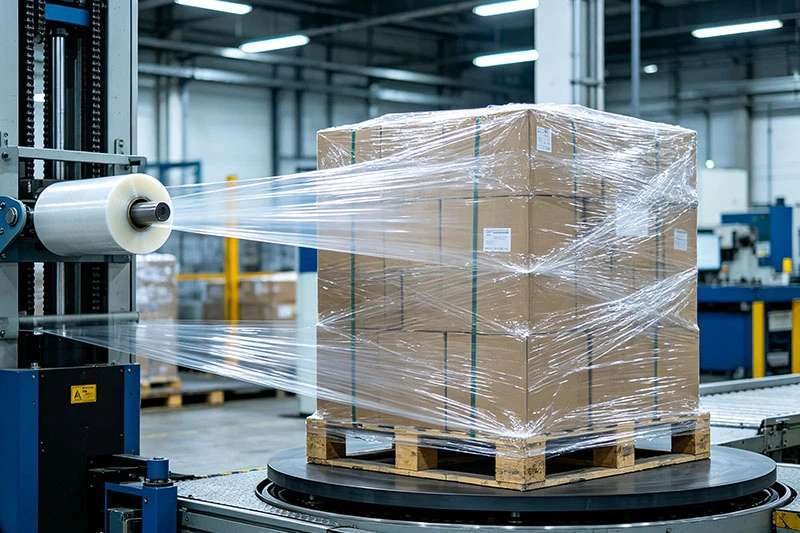


Selecting the right film stretch machine directly impacts packaging line uptime, load containment integrity, and total operational expenditures. For automated packaging operations, optimal film performance depends on three core variables: matching film thickness to pallet load profiles, utilizing proper pre-stretch ratios, and pairing film elasticity with specific wrapping equipment mechanics. Selecting an incorrect film specification causes frequent web breaks, excessive material consumption, and load instability during transit. This guide details the engineering parameters, cost-calculation frameworks, and technical specifications B2B purchasing managers and packaging engineers must evaluate to reduce cost per wrapped pallet while maintaining transport safety.
Key Takeaways
- Cost Per Pallet Over Roll Price: Evaluating stretch film based solely on price per roll leads to higher operational costs. True savings stem from high pre-stretch capability, which reduces the total weight of plastic applied per load.
- Match Gauge to Load Profile: Load profiles (Type A, B, and C) determine required film gauge and puncture resistance. Irregular loads with sharp corners demand higher puncture performance rather than just thicker gauge.
- Optimize Machine Settings: Pre-stretch systems convert mechanical tension into structural holding force. Running high-performance film on mismatched or under-calibrated equipment causes film breakage and load failure.
- Quality Verification Matters: Inconsistent gauge tolerances, poor edge trimming, and improper cling levels are primary drivers of automated line downtime.
Machine Stretch Film vs. Film Stretch Hand: Key Engineering Differences
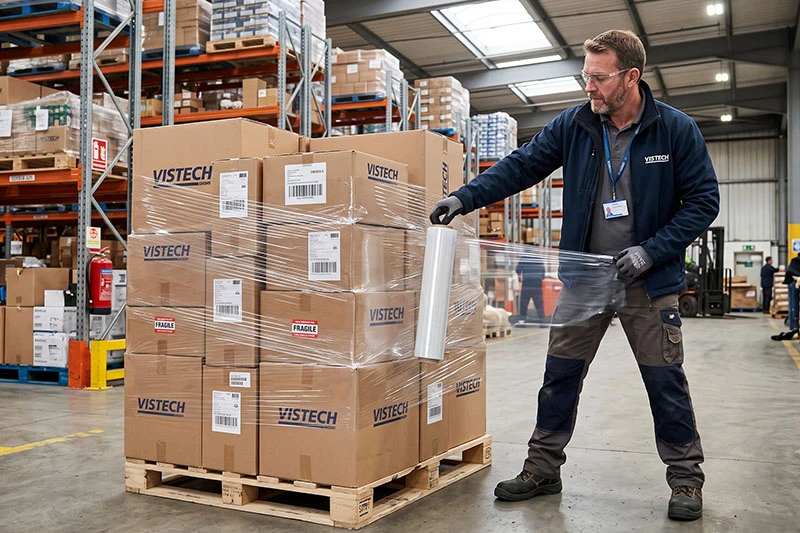
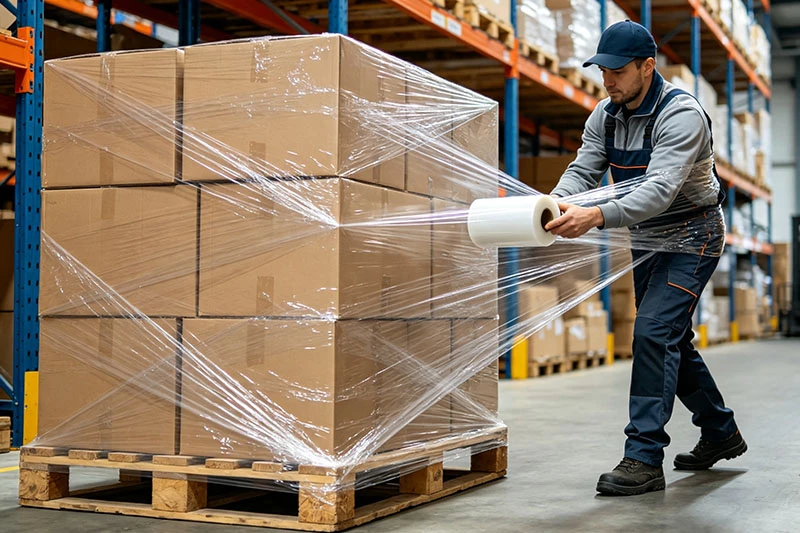
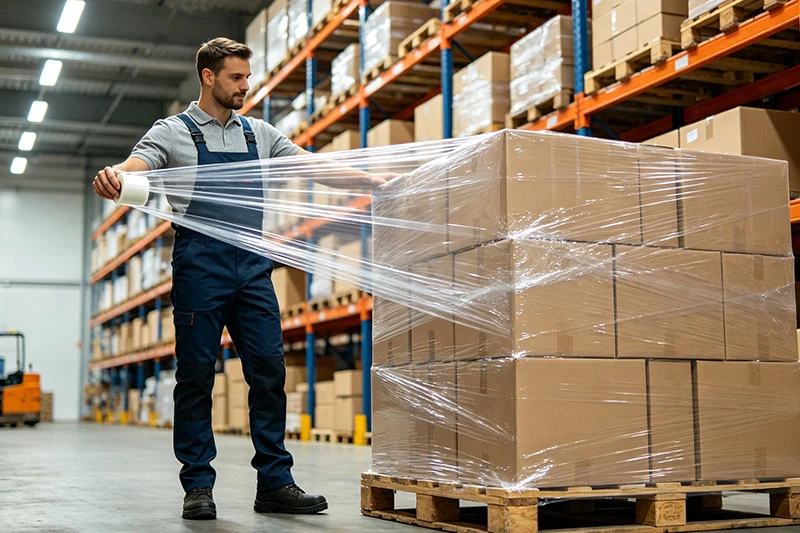
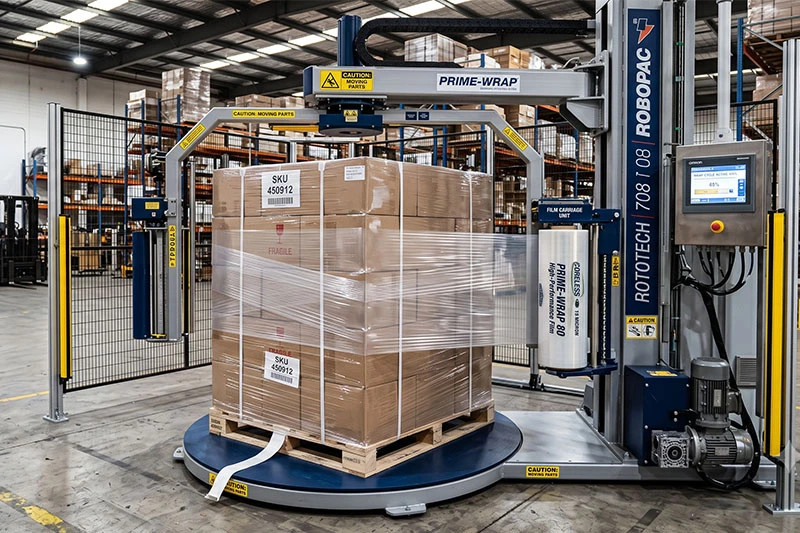
Machine stretch film and hand stretch film serve fundamentally different operational environments. Applying hand film on automated wrappers or attempting manual wrapping with machine-grade rolls impairs load stability and wastes material.
Machine stretch film is engineered for high-speed, high-tension application on powered wrapping equipment. Manufactured primarily via continuous cast extrusion, machine film exhibits high gauge uniformity, controlled cling, and exceptional tear resistance under high mechanical stress. Hand film is designed for manual application, featuring lower yield limits, lighter roll weights for operator ergonomics, and lower ultimate stretch limits.
| Performance Metric | Film Stretch Machine | Film Stretch Hand |
| Primary Extrusion Method | Cast extrusion (predominant) or blown | Cast or blown |
| Elongation / Pre-Stretch Limit | Up to 200% – 300%+ (equipment dependent) | Typically 50% – 100% (manual capability) |
| Gauge Uniformity | High precision tolerance | Moderate tolerance |
| Standard Roll Weights | 30 lbs – 40+ lbs (13.5 kg – 18+ kg) | 8 lbs – 10 lbs (3.5 kg – 4.5 kg) |
| Application Speed | 12 à 45+ RPM automated packaging lines | Manual walking pace |
| Primary Industrial Objective | Cost per load reduction & high-speed containment | Low-volume wrap & spot securing |
Using hand film on powered pre-stretch machinery results in immediate snapping because hand films cannot withstand the rapid elongation ratios exerted by powered rollers. Conversely, mounting heavy machine rolls onto manual dispensers causes operator fatigue and yields poor wrap tension.
Types of Machine Stretch Film: Cast vs. Blown and Pre-Stretched
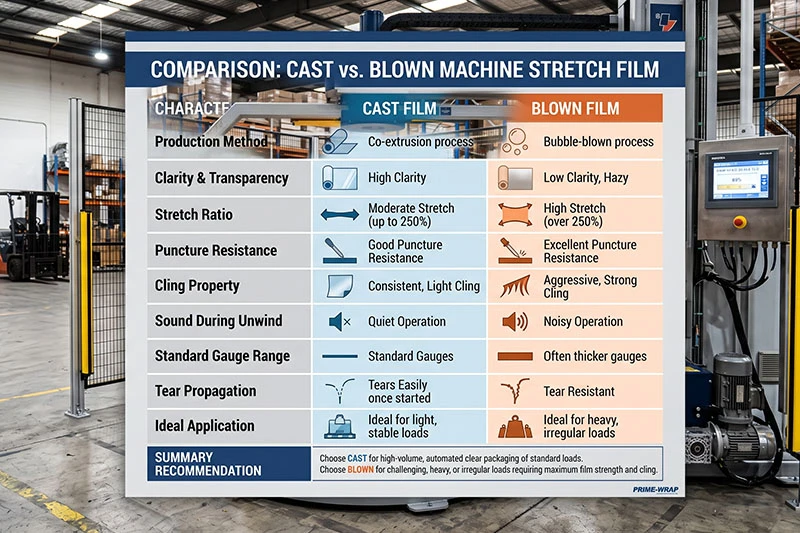
Selecting between cast, blown, and pre-stretched machine films requires balancing optical clarity, noise parameters, resistenza à puntura, and equipment capabilities.
                   ┌─────────────────────────────────────────┐
                   │    Machine Stretch Film Categories      │
                   └────────────────────┬────────────────────┘
                                        │
         ┌──────────────────────────────┼──────────────────────────────┐
         ▼                              ▼                              ▼
┌─────────────────┐            ┌─────────────────┐            ┌─────────────────┐
│  Cast Machine   │            │  Blown Machine  │            │  Pre-Stretched  │
│      Film       │            │      Film       │            │  Machine Film   │
├─────────────────┤            ├─────────────────┤            ├─────────────────┤
│• High Clarity   │            │• High Puncture  │            │• Pre-Elongated  │
│• Quiet Unwind   │            │  Resistance     │            │• Lower Force To │
│• Uniform Gauge  │            │• High Two-Way   │            │  Load           │
│• Smooth Cling   │            │  Tear Strength  │            │• Low Machine    │
│• Fast Lines     │            │• Cold Storage   │            │  Stress         │
└─────────────────┘            └─────────────────┘            └─────────────────┘
Cast Machine Stretch Film
Cast film is produced by feeding molten resin through a flat die onto polished cooling rollers. This rapid cooling process yields exceptional optical clarity, allowing barcode scanners to read labels directly through multiple film layers. Cast film features a quiet unwind mechanism, making it ideal for high-speed facility environments, alongside tight gauge control and smooth surface cling. It represents the standard specification for conventional automated wrapping setups.
Blown Machine Stretch Film
Blown film is manufactured by extruding resin through a circular die into a vertical bubble cooled by ambient air. This slower cooling phase forms a dense, crystalline molecular structure that gives blown film superior puncture resistance, high transverse tear strength, and aggressive two-sided cling. Blown film is chosen for wrapping sharp, heavy, or irregular loads (such as metal stampings, bricks, or raw castings) and performs well in cold-storage environments. Tuttavia, blown film produces high unwinding noise and offers lower optical clarity than cast options.
Pre-Stretched Machine Film
Pre-stretched machine film is mechanically elongated near its ultimate yield point during manufacturing before being wound onto core tubes. Because the film is already pre-stretched, the packaging machine requires minimal force-to-load exertion to apply it. This reduces energy consumption on turntable motor drives and lowers stress on light or crushable pallet loads. Pre-stretched film provides consistent load containment, but it offers less residual stretch reserve for ultra-heavy industrial loads compared to premium cast films run on high-ratio pre-stretch carriage systems.
For most automated operations seeking a balance of high clarity, high output speed, and consistent tensile strength, integrating an advanced high-performance machine stretch film produced via multi-layer cast extrusion yields optimal operational results.
Selection Framework: Matching Gauge, Load Weight, and Wrapper Type
Selecting the correct stretch film specification requires matching the film gauge (thickness) to both the pallet load profile and the specific wrapping machine setup.
Understanding Load Profiles
Packaging engineers classify pallet loads into three distinct profile categories:
- Type A Loads: Uniform, smooth, square profiles with no protrusions. Dimensions match the pallet footprint exactly (e.g., standard boxed consumer goods).
- Type B Loads: Less uniform profiles with minor protrusions, irregular stacking patterns, or slight inner voids (e.g., mixed corrugated cartons, bagged goods).
- Type C Loads: Highly irregular profiles with sharp corners, severe overhang, protrusion hazards, and uneven weight distribution (e.g., industrial machinery parts, raw castings, construction materials).
Selection Matrix
| Load Profile | Load Weight Class | Recommended Thickness (Microns / Gauge) | Equipment Compatibility | Primary Film Requirement |
| Type A | Light (< 1,000 lbs / 450 kg) | 12–15 µm (47–60 Gauge) | Turntable, Rotary Arm | High clarity, smooth cling |
| Type A / B | Medium (1,000–1,800 lbs / 450–800 kg) | 17–20 µm (67–80 Gauge) | Turntable, Rotary Arm, Ring Wrapper | High stretchability, steady neck-down |
| Type B / C | Heavy (1,800–2,500 lbs / 800–1,150 kg) | 23–25 µm (90–100 Gauge) | Rotary Arm, High-Speed Ring Wrapper | High puncture resistance, high holding force |
| Type C | Extra Heavy (> 2,500 lbs / 1,150 kg) | 30+ µm (120+ Gauge) or specialized multi-layer | Heavy-duty Rotary Arm, Automated Ring | Maximum tear resistance, maximum containment |
Wrapping Machine Mechanics
The mechanical operation of your packaging equipment directly limits which film specifications can be used:
┌─────────────────────────────────────────────────────────────────────────┐
│                       Packaging Machine Categories                      │
└────────────────────────────────────┬────────────────────────────────────┘
                                     │
         ┌───────────────────────────┼───────────────────────────┐
         ▼                           ▼                           ▼
┌─────────────────┐         ┌─────────────────┐         ┌─────────────────┐
│ Turntable Wrappers       │ Rotary Arm Wrappers      │ Orbital Ring Wrappers    │
├─────────────────┤         ├─────────────────┤         ├─────────────────┤
│• 10-15 RPM      │         │• 15-30 RPM      │         │• 30-60+ RPM     │
│• Pallet Rotates │         │• Stationary Load│         │• Stationary Load│
│• Moderate Stretch│        │• High Acceleration│       │• Ultra-Fast Line│
└─────────────────┘         └─────────────────┘         └─────────────────┘
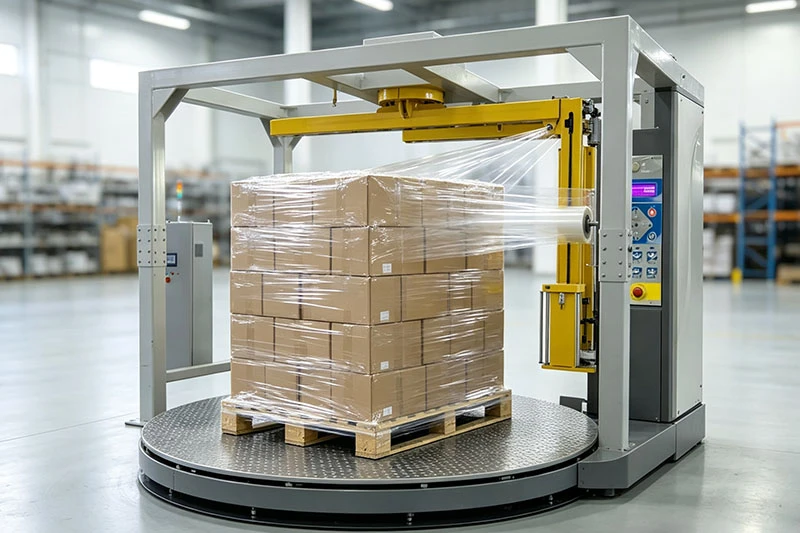
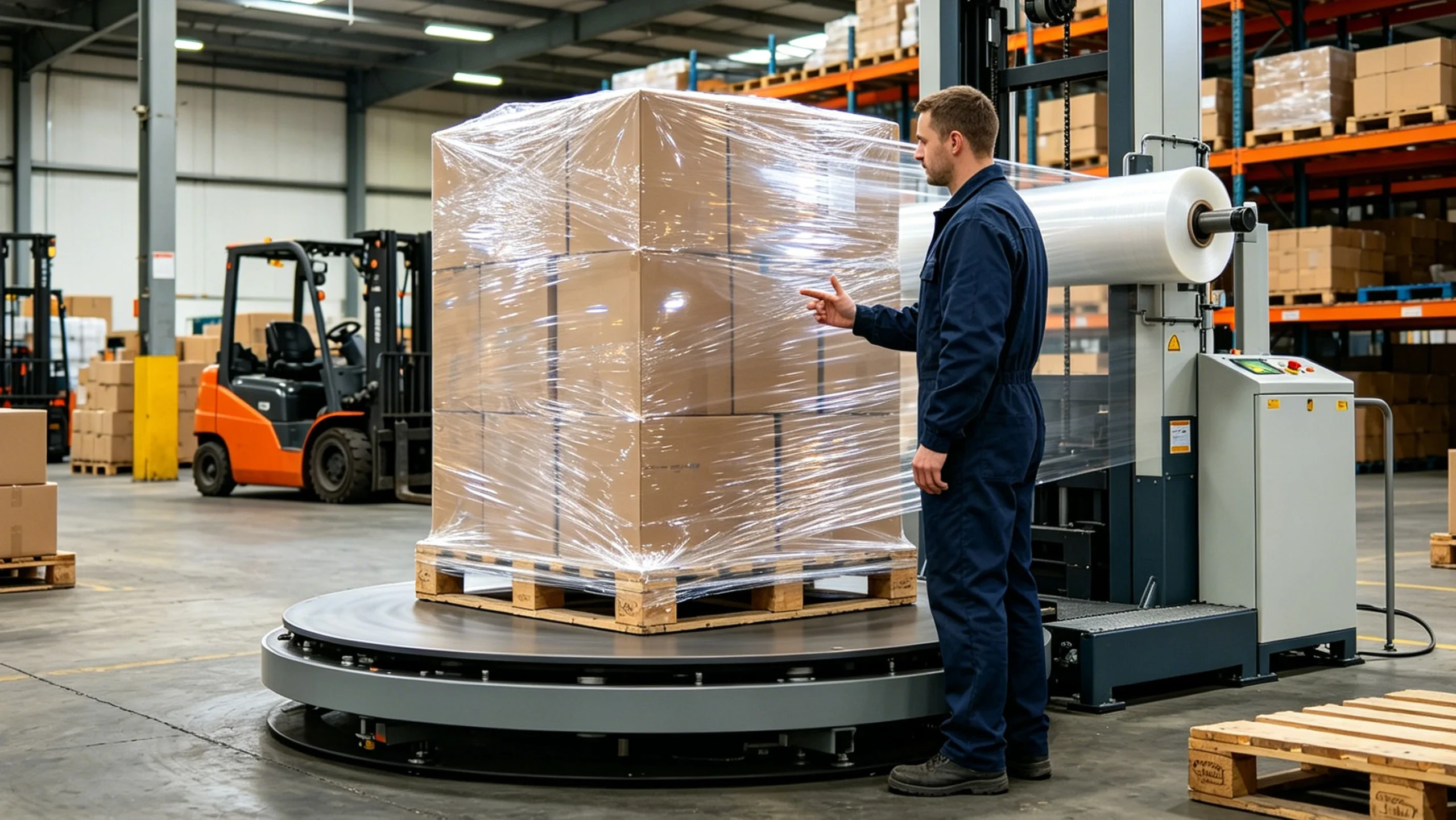
- Turntable Wrappers: Rotate the pallet load on a motorized base while the film carriage moves vertically. Best suited for stable Type A and B loads at processing speeds up to 12–15 pallets per hour.
- Rotary Arm Wrappers: Keep the pallet stationary while a overhead mechanical arm rotates around the load. Essential for unstable, extremely heavy, or light loads that would topple on a turntable system.
- Orbital Ring Wrappers: Utilize a high-speed rotating ring that encircles stationary pallets. These systems operate at high line speeds (up to 60+ pallets per hour) and require high-performance machine stretch film engineered for minimal neck-down and high puncture resistance during rapid acceleration.
Calculating Cost per Wrapped Pallet: The Impact of Pre-Stretch Ratios
Evaluating machine stretch film on a “cost per roll” basis is a common procurement error. Thin, low-grade film with a low price per roll often tears under tension or fails to stretch, requiring operators to apply extra layers. This increases both total material weight and overall cost per pallet.
The Physics of Pre-Stretch
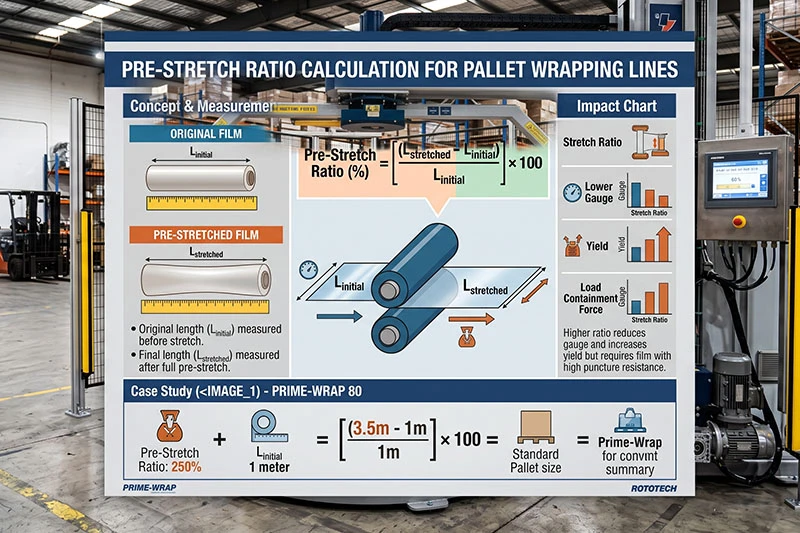
Modern wrapping machines use powered pre-stretch carriages featuring two gears turning at differential speeds. As the film passes between these rollers, it is mechanically elongated before being applied to the pallet.
$$\text{Pre-Stretch Ratio (\%)} = \left( \frac{\text{Stretched Length} – \text{Original Length}}{\text{Original Length}} \right) \times 100$$
For instance, 1 meter of film fed through a carriage operating at a 250% pre-stretch ratio yields 3.5 meters of usable film on the load ($1 \text{ m} + 2.5 \text{ m}$).
Cost Calculation Process
- Weigh Cut Off Film: Wrap a standard test pallet using current machine settings. Cut the film off the pallet and weigh it on a precision scale to determine Grams Per Pallet ($G$).
- Determine Roll Mass: Obtain total net film weight per roll in grams ($W$).
- Calculate Pallets Per Roll:$$\text{Pallets Per Roll} = \frac{W}{G}$$
- Calculate Cost Per Pallet:$$\text{Cost Per Pallet} = \frac{\text{Price Per Roll}}{\text{Pallets Per Roll}}$$
Step-by-Step Practical Example
A factory wraps 200 Type B pallets per day. They are deciding between a standard commodity film and a high-performance machine stretch film.
- Option A (Standard Film): $40.00 per roll. Pre-stretch capability is capped at 150% before breaking. Weight of film used per pallet = 300 grams.
- Option B (Film Stretch Machine d'Alta Prestazione): $50.00 per roll. Stable pre-stretch capability up to 250%. Weight of film used per pallet = 180 grams (due to higher elongation and thin-gauge retention).
Assuming a standard 15 kg (15,000 g) net film roll weight:
- Option A Calculation:
- Pallets per roll: $15,000 \text{ g} / 300 \text{ g} = 50 \text{ pallets}$
- Cost per pallet: $\$40.00 / 50 = \mathbf{\$0.80 \text{ per pallet}}$
- Option B Calculation:
- Pallets per roll: $15,000 \text{ g} / 180 \text{ g} = 83.3 \text{ pallets}$
- Cost per pallet: $\$50.00 / 83.3 = \mathbf{\$0.60 \text{ per pallet}}$
Result: Option B costs $10.00 more per roll, yet yields a 25% reduction in total wrapping cost per load, saving $40.00 per day ($8,000+ annually per machine line) while reducing plastic waste disposal volumes.
Procurement Checklist: Evaluating Quality Parameters Before Buying
To maintain consistent wrap quality and prevent line stoppage, buyers should run pilot trials and evaluate sample rolls against five key technical metrics:
┌─────────────────────────────────────────────────────────────────────────┐
│                       Quality Verification Metrics                      │
├───────────────────┬───────────────────┬─────────────────────────────────┤
│ Verification Area │ Technical Metric  │ Quality Risk / Issue            │
├───────────────────┼───────────────────┼─────────────────────────────────┤
│ Gauge Uniformity  │ Thickness Tol.    │ Thin spots cause snap breaks    │
│ Roll Edge Quality │ Clean Slit Edges  │ Nicks trigger web tears         │
│ Holding Force     │ Residual Retention│ Loose film leads to load shift  │
│ Cling Properties  │ One/Two-Sided Tack│ Tails unwrap during transit     │
│ Core Integrity    │ Uncrushed Paperboard Core crushing stalls carriage │
└───────────────────┴───────────────────┴─────────────────────────────────┘
Technical Inspection Checklist for Buyers
- [ ] Gauge Tolerance Check: Measure film thickness across the web width using a micrometer. Gauge variation should not exceed $\pm 5\%$ of nominal thickness. Localized thin spots lead to web snaps at high stretch ratios.
- [ ] Roll Edge Inspection: Inspect the physical edges of the roll core. Edges must be cleanly slit with zero nicks, tears, or telescoping. Micro-cracks on roll edges propagate across the entire web once stretched under high carriage speeds.
- [ ] Puncture Resistance Test: Test load resistance on corners using a point-puncture gauge. The film must deform and stretch around sharp corners without propagating a running tear.
- [ ] Cling Performance: Ensure the inner surface provides sufficient tack to bind film layers together without transferring residue. Outer cling must be low enough to prevent adjacent wrapped pallets from sticking together during truck transport (“pallet interlocking”).
- [ ] Core Condition: Verify that internal paperboard cores are thick, rigid, undamaged, and uncrushed. Deformed cores cause carriage chatter, uneven unwinding, and shaft locking.
Frequently Asked Questions About Machine Stretch Film
What is the ideal pre-stretch ratio for standard machine stretch film?
Standard machine stretch films typically operate at pre-stretch ratios between 150% è 200%. High-performance multi-layer cast machine films can achieve pre-stretch ratios between 250% è 300%+ without snapping or tearing, depending on machine mechanical settings and film formulation.
Why does machine stretch film break during wrapping, and how to fix it?
Film breakage usually stems from five core issues:
- The pre-stretch carriage ratio exceeds the film’s maximum yield point.
- Roll edges have physical damage or nicks.
- Roller settings or tension settings (force-to-load) are set too high for the load geometry.
- The film thickness is insufficient for the load’s sharp edges (Type C loads).
- The machine’s rubber rollers are worn or contaminated, causing uneven strain across the web.
How do I determine if my wrapping machine requires cast or blown film?
If your operation runs high-speed automated machinery wrapping standard boxed or uniform loads where scanning barcodes through the film is required, cast film is the best choice due to its clarity and quiet unwind. If your facility wraps cold-stored items, heavy machinery, sharp castings, or irregular Type C loads, blown film is recommended for its high puncture resistance and two-way tear strength.
Optimize Your Automated Wrapping Line with Vistech
Optimizing your automated packaging process requires matching film resin performance, gauge profile, and machine stretch capabilities to your specific operational environment.
At Vistech Stretch Film Limited, our manufacturing excellence is anchored by modern automated palletizing and packaging systems, a highly knowledgeable team of R&D engineers, and dedicated, cutting-edge stretch film production lines. We help industrial clients minimize wrap failures, lower plastic consumption, and achieve consistent load containment across global supply chains.
Ready to lower your cost per wrapped pallet and eliminate unnecessary machine downtime? Contact Vistech’s packaging engineering team to request a trial roll sample or schedule an operational evaluation for your packaging lines.