

1. Introduction
In supply chain management, Os materiais de embalaxe secundario adoitan clasificarse incorrectamente como consumibles de baixo valor, levando a ineficiencias de contratación ignoradas. Entre estes, manual stretch film is critical for securing palletized loads and preventing transit damage. Porén, As comparacións superficiais de prezos por rolo adoitan enmascarar os custos ocultos, resultando en fallos materiais ou presupostos inflados. To help procurement officers and warehouse managers optimize expenses, this evaluation details common market pitfalls, outlines quality-verification metrics, and provides a quantitative framework to achieve measurable cost reduction without compromising load containment.

2. Hidden Pitfalls in Manual Stretch Film Procurement
The industrial marketplace contains various sub-standard products designed to simulate high-quality films while reducing actual performance. Procurement teams must identify three primary cost traps:
- Excessive Core Weight (The “Heavy Core” Trap): A common deceptive practice involves winding film onto disproportionately thick, heavy paper cores. A low per-roll price often indicates that a significant percentage of the gross weight consists of cheap paperboard rather than functional LLDPE film. Buyers end up paying polymer prices for disposable paper scrap.
- Adulteration with Recycled Regrinds: To lower production costs, some manufacturers blend post-industrial or post-consumer recycled plastics into the melt. This contamination degrades polymer chain networks, reducing optical clarity and causing premature tearing during manual application.
- Unreported Gauge Reduction (Under-Gauging): Unscrupulous suppliers may deliver films that are $2\,\mu\text{m} – 3\,\mu\text{m}$ thinner than specified. While this reduces the raw material used per roll, it compromises puncture resistance, forcing warehouse operators to apply extra layers to prevent failure, which increases overall material consumption.
3. Core Quality Verification Metrics
To eliminate purchasing risks, procurement contracts should mandate strict compliance with verifiable physical properties, moving past basic visual inspections:
┌───────────────────────────────────────────────────────────────────────┐
│                    QUALITY VERIFICATION METRICS                       │
├───────────────────────────────────┬───────────────────────────────────┤
│ • Net Weight Ratio (Film vs Core) │ • Optical Clarity & Light Trans.  │
│ • Ultimate Tensile Strength       │ • Dart Drop Puncture Resistance   │
│ • Elastic Recovery Force          │ • Consistent Cling Coefficient    │
└───────────────────────────────────┴───────────────────────────────────┘
A premium manual stretch film made from 100% virgin LLDPE should feature an ultra-thin, high-density paper or plastic core to maximize net film weight. When stretched manually, the film must deform uniformly without localized thinning or tearing, maintaining a high elastic recovery force that keeps the pallet load tightly compressed.

4. The Quantitative Procurement Formula: Shifting from “Per-Roll” to “Per-Meter” Costing
Evaluating manual stretch film solely on a “price-per-roll” basis creates a significant blind spot. True financial optimization requires calculating the net cost per linear meter and the actual cost per wrapped pallet.
The standard engineering formula to determine the theoretical net weight ($W_{\text{net}}$) of a film roll is:
$$W_{\text{net}} = L \times w \times T \times \rho$$
Where:
- $L$ = Length of the film on the roll (meters)
- $w$ = Width of the film (meters, typically $0.45\,\text{m}$ or $0.50\,\text{m}$)
- $T$ = Thickness of the film (meters, e.g., $20\,\mu\text{m} = 20 \times 10^{-6}\,\text{m}$)
- $\rho$ = Density of LLDPE resin (approximately $0.92 \times 10^{3}\,\text{kg/m}^3$)
By calculating the true net weight and subtracting it from the gross weight delivered, procurement teams can verify the exact weight of the paper core. Comparing different suppliers using the Cost per Net Kilogram ou Cost per Functional Meter ensures transparent bidding and exposes artificially low prices based on heavy cores or short-rolled lengths.
5. Operational Optimization: Achieving Cost Reduction Through Efficiency
Reducing procurement costs requires both purchasing verification and operational efficiency on the warehouse floor:
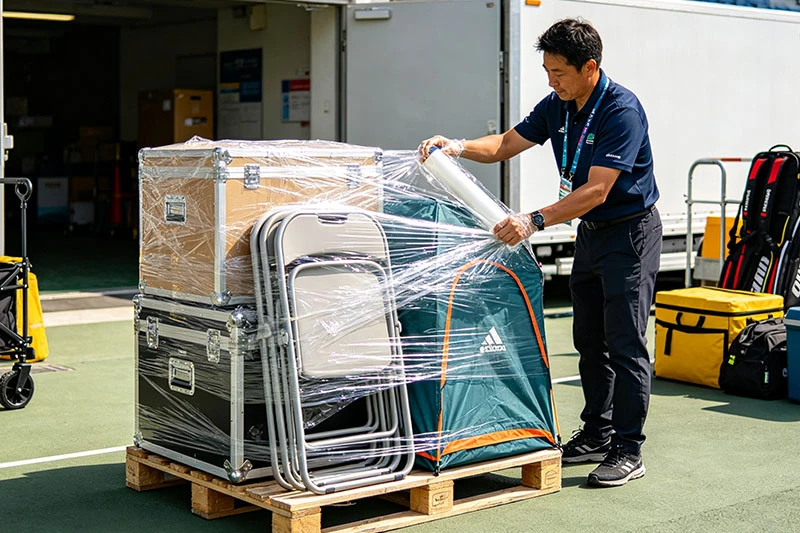
- Standardizing the Wrapping Profile: Warehouses should establish strict wrapping guidelines tailored to specific load profiles. For example, a standard $1.2\,\text{m} \times 1.0\,\text{m} \times 1.5\,\text{m}$ pallet might require exactly three base layers, two interlocking middle layers, and three top layers. Preventing unstandardized over-wrapping stops material waste.
- Adopting Ergonomic Hand-Dispensing Tools: Implementing lightweight, mechanical hand-wrappers with adjustable brake tension allows operators to safely exploit the film’s natural elongation ($100\% – 150\%$ under human strength). This pre-stretching stretches the film further per roll, reducing material consumption per pallet by up to 25% while lowering worker fatigue.
6. Comprehensive Life-Cycle Cost Analysis
When analyzing packaging expenses, total cost of ownership (TCO) must take precedence over initial material costs. Using sub-standard, low-cost manual stretch film often leads to downstream financial losses:
| Cost Category | High-Purity Virgin Film | Sub-Standard Recycled Film |
| Initial Purchase Price | Standard Market Rate | Below Market Average |
| Average Wrapping Layers | Optimized (e.g., 2-3 layers) | Elevated (e.g., 5+ layers needed to match strength) |
| In-Process Tearing Rate | Near $0\%$ under normal tension | High (causes operator downtime and waste) |
| Pallet Containment Integrity | High (prevents shifting during transport) | Poor (susceptible to load shifting and failure) |
| Downstream Transit Damage Risk | Negligible | High (increases claims for broken products) |
7. Warehouse Implementation and Material Audit Protocols
To maintain long-term savings, organizations should integrate film audits into standard warehouse operations:
- Random Inbound Audits: Weigh sample rolls upon arrival to verify gross weight, then strip the film to cross-reference the core weight against the supplier’s technical data sheet.
- Visual Clarity and Odor Screen: Virgin LLDPE manual stretch films are transparent and odorless. A yellowish or grayish tint, combined with a distinct chemical odor, indicates recycled regrinds that may fail under structural tension.
- Consumable Tracking: Monitor monthly roll consumption against total shipped pallet volume to identify shifts in operator habits or unannounced variations in film quality.

8. Conclusion
Optimizing expenditures on manual stretch film requires a data-driven approach that balances procurement verification with operational discipline. By rejecting superficial per-roll pricing and using net-weight formulas, companies can eliminate vendor fraud, protect against sub-standard materials, and lower packaging costs. Combined with standardized wrapping protocols and proper hand-dispensers, sourcing high-purity LLDPE films ensures maximum load stability, reduced workplace waste, and protected supply chain operations.