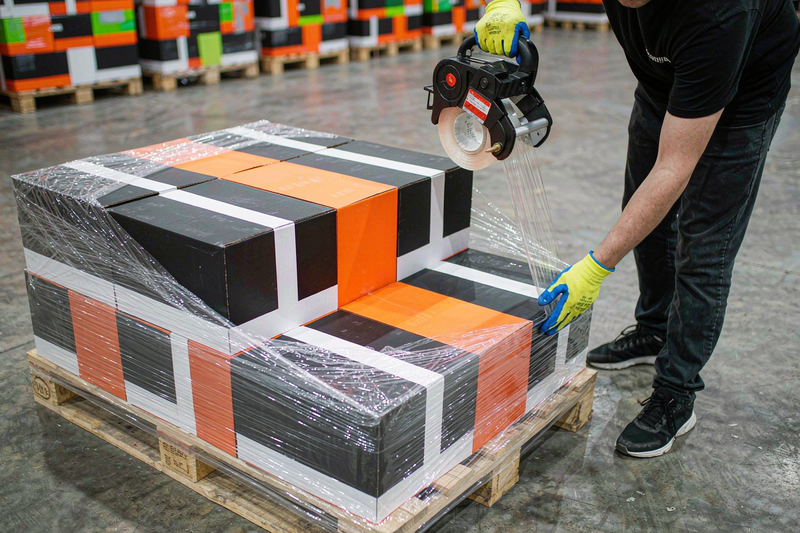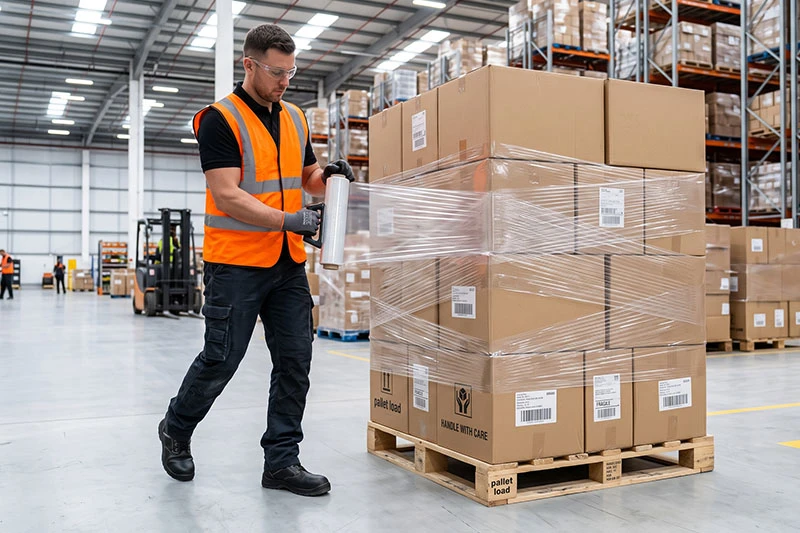


Selecting the correct hand stretch film thickness determines whether a palletized load arrives intact or collapses in transit due to shifting and puncture failures. मैन्युअल रैपिंग ऑपरेशन के लिए, फिल्म की मोटाई आम तौर पर से होती है 12 माइक्रोन ($\मु म$) हल्के वजन के लिए, एक समान सामान तक 30 भारी के लिए माइक्रोन, अनियमित औद्योगिक कार्गो. Choosing the right gauge is a balance between load containment and packaging cost: a film that is too thin tears during handling, while an unnecessarily thick film inflates roll procurement expenses and increases manual wrapping fatigue.
This guide outlines standard thickness measurements, breaks down load suitability across the 12 को 30 micron spectrum, and details how cargo geometry impacts film selection.
Why Stretch Film Thickness Matters: Balancing Load Security and Material Cost
In manual pallet wrapping, film thickness dictates holding force (नियंत्रण बल), पंचर प्रतिरोधी, and tensile strength under stress. Packaging managers often default to heavier gauges assuming higher thickness automatically guarantees safety. तथापि, over-specifying thickness adds dead weight and unnecessary cost per pallet wrapped without improving load stability.
Conversely, under-specifying thickness leads to catastrophic load failure. When a thin film stretches past its yield point on a heavy pallet, it experiences tear propagation—a minor puncture at a sharp corner quickly splits the entire web width. Balancing thickness requires evaluating total load mass, transport vibration, and the presence of sharp protruding edges.
Understanding Stretch Film Measurements: Micron ($\मु म$), Gauge, and Mil
International procurement often involves different unit systems depending on the supplier’s geographic base. Stretch film thickness is measured in microns ($\मु म$), गेज, or mils.
- Micron ($\मु म$): The metric unit where $1\ \mu m = 0.001\text{ mm}$.
- Gauge: A standard North American unit ($1\text{ mil} = 100\text{ गेज}$).
- Mil: One-thousandth of an inch ($0.001\text{ inch}$).
To convert microns to gauge, multiply the micron value by 3.937 (or roughly 4). The table below outlines standard unit equivalents used across global packaging supply chains:
| Thickness (माइक्रोन) | Thickness (Gauge) | Thickness (Mils) | Typical Industry Classification |
| 12 – 15 $\मु म$ | 48 – 60 Gauge | 0.47 – 0.59 mil | Ultra-thin / Pre-stretched Hand Film |
| 17 – 20 $\मु म$ | 68 – 80 Gauge | 0.67 – 0.79 mil | Standard Industrial Hand Wrap |
| 23 – 25 $\मु म$ | 90 – 100 Gauge | 0.90 – 0.98 mil | Heavy-Duty Hand Wrap |
| 28 – 30 $\मु म$ | 110 – 120 Gauge | 1.10 – 1.18 mil | Extra Heavy-Duty / High-Puncture Wrap |
Evaluating standard hand stretch film solutions against these unit benchmarks prevents ordering errors when sourcing from international manufacturers.

Choosing the Right Thickness: 12 को 30 Micron Breakdown by Load Type
Selecting the proper micron level requires categorizing the pallet by weight and stacking uniformity.
       12–15 µm                   17–20 µm                   23–30 µm
[ Light Loads / <500kg ]    [ Medium / 500–900kg ]    [ Heavy / 900–1200+ kg ]
  Uniform carton boxes        Mixed distribution        Rough, sharp, jagged
12 को 15 माइक्रोन (48–60 Gauge): Pre-Stretched & Light-Duty Applications
Films in the 12 को 15 micron range are primarily engineered as pre-stretched films or applied to light, uniform loads weighing under 500 kg (1,100 lbs). Pre-stretched hand film is elongated during manufacturing, meaning warehouse workers require less physical tension to apply the film securely.
- Suitable for: Lightweight corrugated boxes, paper goods, snack foods, empty containers.
- Limitations: Low resistance to sharp protrusions; unsuitable for loose, jagged pallet configurations.
17 को 20 माइक्रोन (70–80 Gauge): The Versatile Industry Standard
The 17 को 20 micron bracket represents the most common specification in general warehousing and logistics, handling weights between 500 kg and 900 kg (1,100 को 2,000 lbs). An 80-gauge (20 $\मु म$) manual wrap provides sufficient yield strength to secure standard carton stacks while retaining elasticity to absorb transport shock.
- Suitable for: Standard boxed consumer goods, beverage cans in trays, palletized retail products.
- Limitations: May require extra layers at the base or corners when wrapping unboxed components.
23 को 30 माइक्रोन (90–120 Gauge): Heavy-Duty, Irregular, and Sharp-Edged Cargo
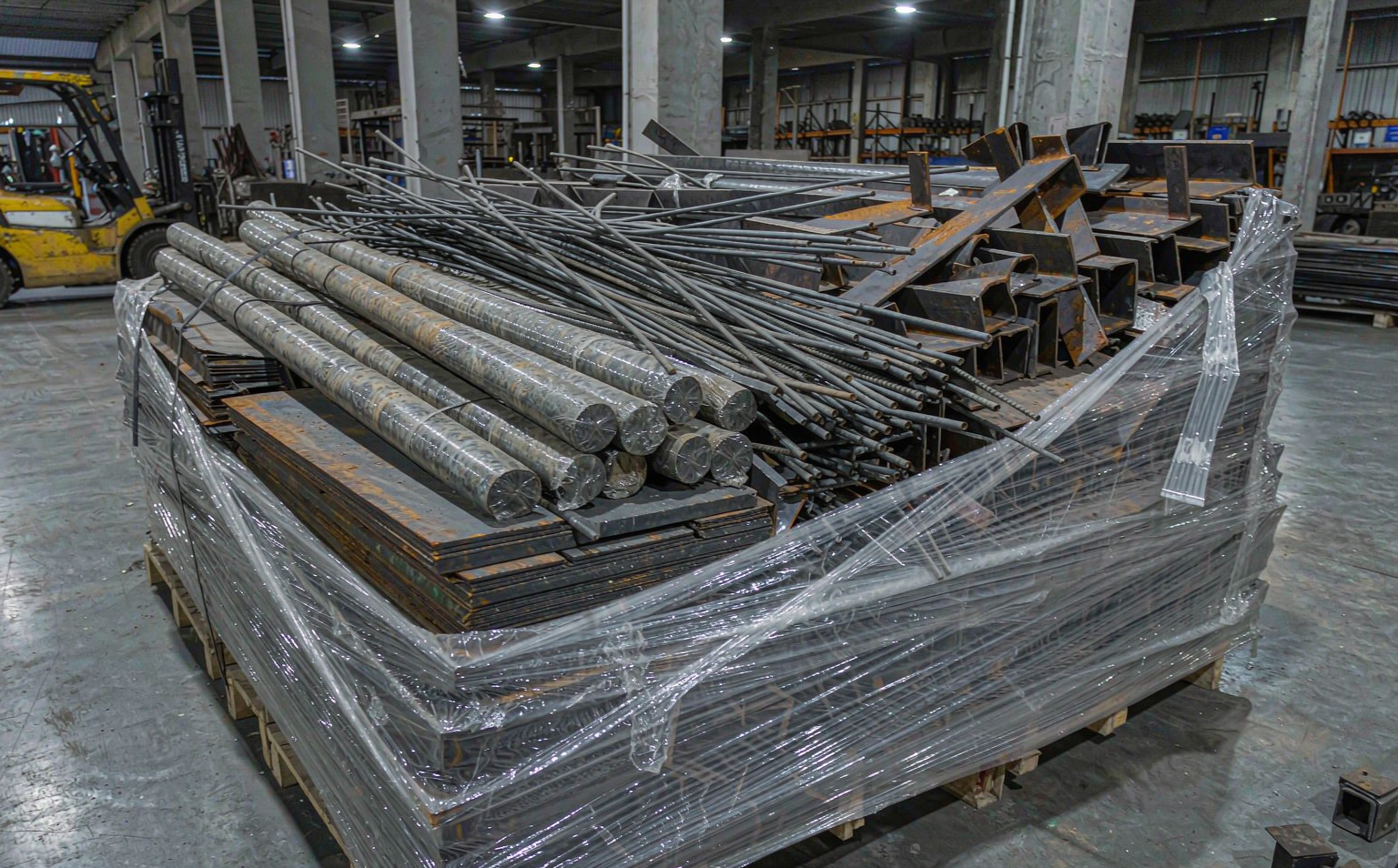
Heavy loads exceeding 900 kg (2,000 lbs) or items with non-uniform geometries require films between 23 and 30 माइक्रोन. This thickness tier delivers high puncture resistance, preventing tears from expanding across the wrap when exposed to pallet splinters, metal parts, or rough edges.
- Suitable for: Castings, metal stampings, construction materials, bagged raw chemicals, irregular machinery components.
- Limitations: Higher roll weight increases operator fatigue during prolonged manual application; higher material cost per roll.
+-------------------+--------------------+-----------------------+----------------------------------+
| Thickness Range   | Max Pallet Weight  | Load Uniformity       | Recommended Application          |
+-------------------+--------------------+-----------------------+----------------------------------+
| 12 – 15 Microns   | < 500 kg           | High (Smooth Boxes)   | Paper products, light FMCG       |
| 17 – 20 Microns   | 500 – 900 kg       | Moderate (Mixed SKU)  | Standard warehousing, logistics  |
| 23 – 30 Microns   | 900 – 1,200+ kg    | Low (Sharp/Irregular) | Industrial machinery, metal parts|
+-------------------+--------------------+-----------------------+----------------------------------+
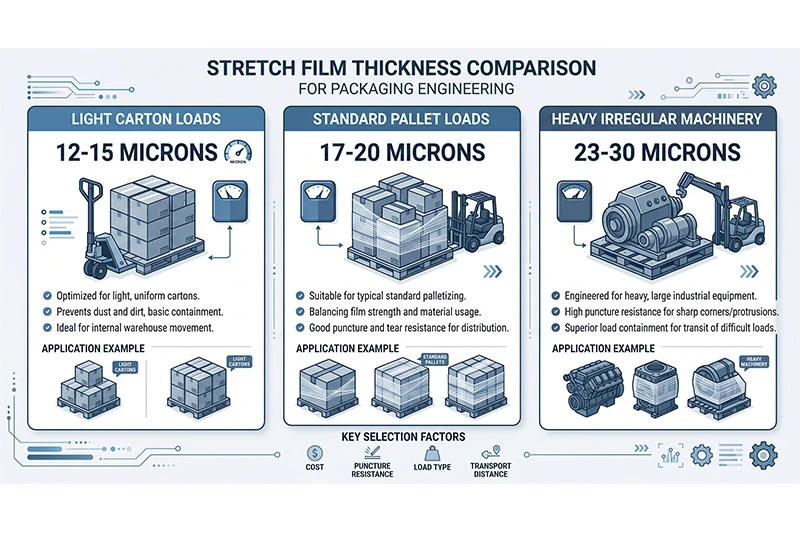
How Load Profile and Weight Dictate Your Hand Film Selection
Load profile classification—defined by international packaging standards—categorizes pallets based on geometry and puncture risk:
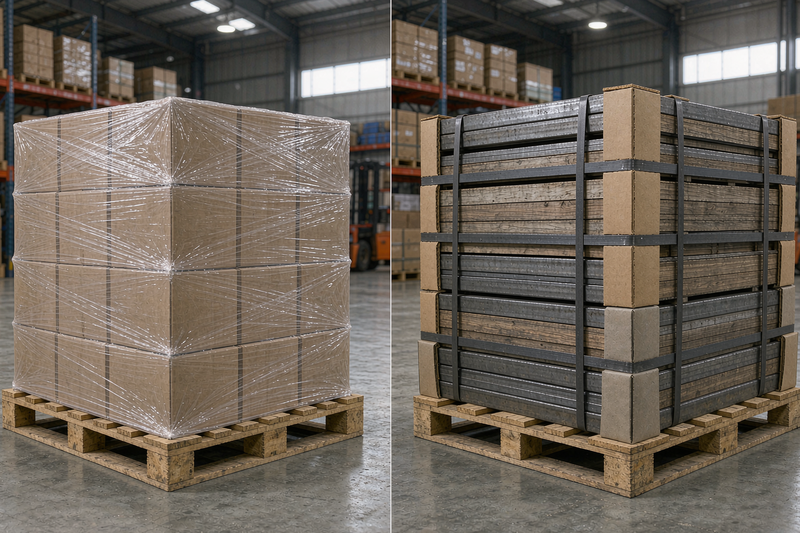
- Type A Profile (Uniform & Smooth): The load matches the pallet footprint exactly with no protrusions or sharp corners (e.g., full pallet loads of identical corrugated shipping cartons). These loads exert uniform tension and can be safely secured using 12 को 17 micron films.
- Type B Profile (Moderate Inconsistencies): The stacking pattern contains minor recesses, uneven box placement, or small step-downs up to 3 inches (75 mm). These variations introduce localized tension points. A 17 को 20 micron wrap is recommended to maintain stability without puncturing.
- Type C Profile (Severe Irregularities): Highly irregular cargo featuring sharp points, overhangs greater than 3 inches, or jagged edges (e.g., exposed wooden crates, piping, bagged aggregate). To avoid tears that destroy pallet integrity, use 23 को 30 micron industrial hand pallet wrap.
Beyond Thickness: Resin Quality, कास्ट बनाम. Blown, and Multi-Layer Extrusion
Micron rating is a primary baseline, but extrusion technology and polymer composition directly influence real-world performance:
- कास्ट बनाम. Blown Extrusion: Cast stretch film offers high clarity, smooth roll unwind, and quiet application, making it suitable for standard warehouse environments. Blown stretch film possesses higher tear resistance and tacky double-sided cling, making it effective for cold storage or securing abrasive loads even at slightly lower gauges.
- Multi-Layer Co-Extrusion (3 को 7+ Layers): Advanced multi-layer extrusion aligns linear low-density polyethylene (LLDPE) polymers to deliver superior puncture resistance. A high-performance 15-micron multi-layer film can often match the holding force of a standard 20-micron single-layer film, reducing total plastic consumption per pallet.
4-Step Checklist to Test and Validate Film Thickness in Your Warehouse
- Verify Nominal Thickness: Use a calibrated mechanical micrometer or calculate roll density (Roll Net Weight $\div$ [Roll Width $\times$ Roll Length $\times$ Polymer Density]) to confirm the supplied film meets the specified micron tolerance.
- Conduct a Puncture Resistance Test: Wrap a Type B or C test pallet and manually push a blunt object (such as a pen corner) against the stressed film web. A quality film should resist rapid tear propagation.
- Inspect Base and Top Layer Retention: Ensure that 3 को 4 wraps at the pallet base lock the load securely to the wooden pallet without breaking during manual tensioning.
- Calculate Cost-Per-Load: Measure the total weight of discarded film after unwrapping a test pallet. Multiply that weight by the price per kilogram of the roll:
$$\text{Packaging Cost per Pallet} = \text{Discarded Wrap Weight (kg)} \times \text{Roll Price per kg}$$
Comparing this figure reveals whether switching to a thinner, higher-grade film reduces total operating cost.
Key Takeaways
- 12–15 Microns: Best suited for uniform Type A pallets under 500 kg; pre-stretched varieties reduce physical operator fatigue.
- 17–20 Microns: The baseline standard for general distribution, handling mixed-carton loads up to 900 kg.
- 23–30 Microns: Designed for Type C loads, sharp edges, and heavy industrial freight exceeding 900 kg.
- Load Profile Matters: Geometric irregularities (Type C profiles) require stepping up in film thickness regardless of the total load weight.
- Total Cost Efficiency: Thinner, high-performance co-extruded films can often match thicker commodity films while lowering cost per pallet wrapped.
Frequently Asked Questions (FAQ)
Can I replace a standard 20-micron film with a 12-micron pre-stretched film?
Yes, provided the pallet load is uniform (Type A profile) and weighs under 500 kg. Pre-stretched film cannot be stretched significantly further by hand, so manual wrapping requires applying adequate tension to secure the top and base layers.
What is the best hand stretch film thickness for cold-storage facilities?
For cold or sub-zero environments, use a 20 को 23 micron blown film or cold-rated cast film. Cold temperatures reduce film elasticity and increase brittleness, making slightly thicker gauges necessary to prevent cracking under strain.
How many wraps of hand film are needed per pallet?
A standard pallet requires 3 को 4 turns at the bottom to secure the goods to the wooden base, 2 को 3 overlapping layers (with a 50% overlap) up the sides, and 3 को 4 turns at the top. For heavier or irregular loads wrapped in thinner films, add 1 को 2 extra base wraps.