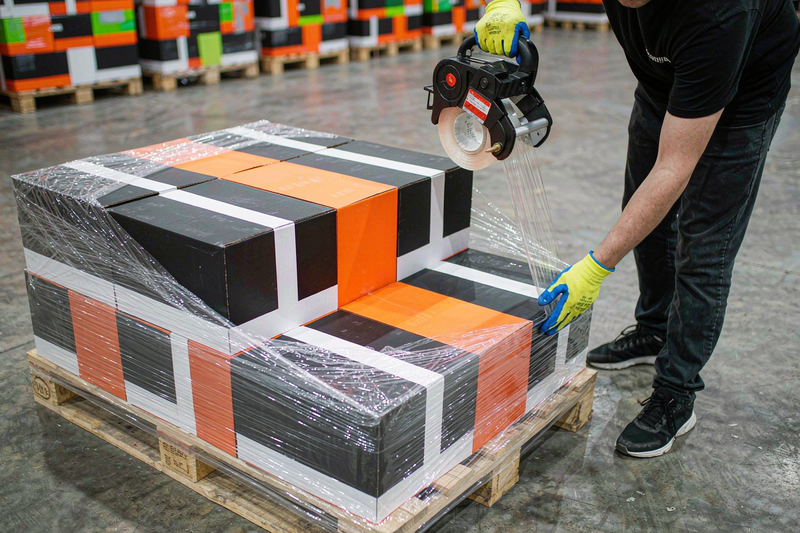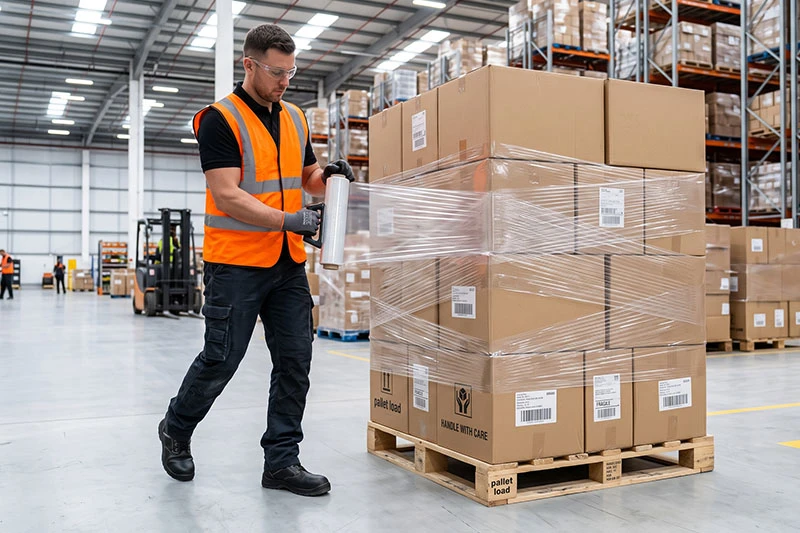


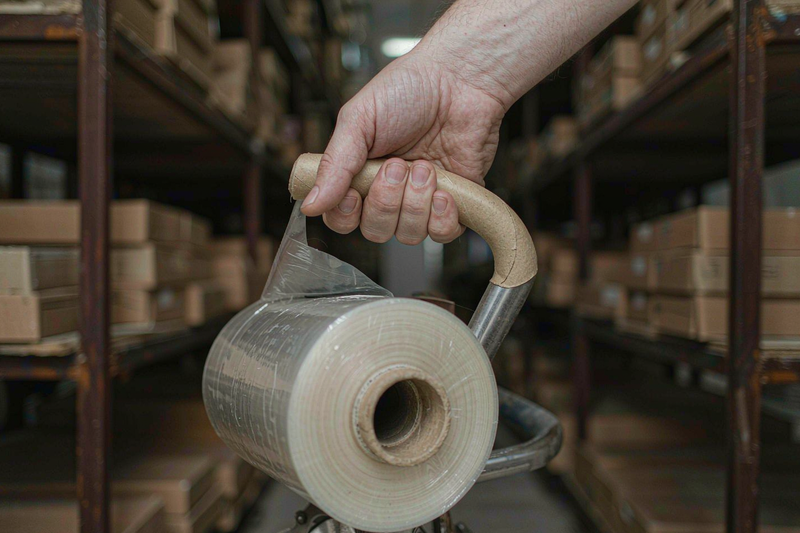
The ergonomic difference between extended core and standard core hand stretch film comes from how the worker holds the roll, not from the film itself. Extended core uses a longer cardboard tube that protrudes beyond the film width on both sides, giving the operator a built-in handle. Standard core uses a short core that sits flush with the film, which means the worker either grips the bare film edge or fits the roll into a separate dispenser. The first format trades some film yield and roll cost for fewer moving parts in the operator’s hands; the second trades convenience for lower consumable cost per metre and the option of a higher-grade dispenser.
Choosing between them is rarely a question of which film is better, and almost always a question of how many pallets a worker wraps per shift, whether they wrap in fixed positions or move around the warehouse, and how much strain the operation can absorb in turnover, sick leave, and rework.
What Extended Core and Standard Core Actually Are
The terminology refers to the cardboard tube at the centre of the roll, and the two formats serve different ergonomic goals.
Extended core rolls use a cardboard tube that extends beyond the film width, typically 4 ka 8 centimetres of cardboard protruding on each side. The worker holds the cardboard directly, so the roll can be applied without a dispenser. The film itself is narrower than the core; the rest of the tube acts as a handle. Extended core rolls are usually lighter per metre of usable film because there is no plastic spool inside, but the tube itself adds core weight that has to be carried and disposed of.
Standard core rolls use a short core that sits flush with the film edge, or protrudes only slightly. The core is typically a 1.5-inch or 3-inch ID cardboard tube sized to fit a dispenser. The worker applies the film by gripping a dispenser that the roll slides onto, by holding the core directly, or in some lower-grade operations by pinching the film edge itself. Standard core is the format most warehouses default to because it is the format most mills ship and the format most dispensers accept.
Both formats can wrap the same load successfully. The question is how the worker interacts with the roll over a shift, and how that interaction affects fatigue, error rate, and turnover.
Where Ergonomic Strain Comes From in Hand Wrapping
Hand wrapping strain is concentrated in three places: the hand and wrist that grips and rotates the roll, the forearm and shoulder that support the roll’s weight away from the body, and the lower back that bends and twists when the operator reaches the bottom and top layers of the pallet. The right roll format reduces strain at the source; the wrong one forces the worker to compensate in ways that compound over a shift.
Grip force and wrist position
Pinch-gripping the edge of a bare film roll, which is common with cheaper standard core rolls that arrive without a dispenser, puts the small muscles of the hand under sustained load and forces the forearm into a pronated position (palm down) for the entire wrap. Over a shift, this is the most common source of wrist tendinitis complaints in hand-wrapping operations. A wider grip, even one that is just the cardboard core, distributes load across more of the hand and lets the wrist sit closer to neutral.
Roll weight and reach distance
A standard core roll of 23-micron hand film at 500 mm width can weigh 4 ka 6 kg depending on length; an extended core roll of the same film and length is usually 10 ka 20 percent lighter because the spool is replaced by a wider cardboard tube. That weight has to be held out from the body at arm’s length for the top layers, and the further the roll sits from the centre of gravity, the more shoulder and upper-back load is added to the hand’s work.
Bending and twisting at the pallet
Both formats still require the operator to bend for the bottom layers and reach for the top. The format choice does not eliminate this; it changes how much additional strain is layered on top of the unavoidable movement. A roll that is easier to grip and lighter to hold reduces how much the back has to compensate for arm fatigue, which is often the real source of back-pain complaints that get attributed to bending alone.
Extended Core vs. Standard Core: Ergonomics Compared
The table below compares the two formats on the factors that drive ergonomic outcomes in a real warehouse. It is not a specification comparison; both formats can be specified with the same film grade, thickness, and width.
| Factor | Extended Core | Standard Core |
|---|---|---|
| Grip | Worker holds the wider cardboard tube directly; palm-sized surface, neutral wrist | Worker grips a dispenser, the bare core, or the film edge; grip surface and wrist position depend on the dispenser |
| Roll weight for the same film | Typically 10–20% lighter because no plastic spool | Heavier per roll due to spool mass; weight depends on spool material |
| Dispenser needed | No | Recommended; bare-roll application causes most pinch-grip strain |
| Start and stop control | Operator’s hand controls tension directly; more forgiving of pauses | Dispenser brake controls tension; quality varies widely between dispensers |
| Noise on unwind | Quieter; cardboard absorbs vibration | Louder, particularly with cheap plastic spools |
| Per-metre film cost | Usually 5–15% higher; lower manufacturing volumes | Lower; this is the format most mills ship as stock |
| Disposal at end of roll | Larger empty core to break down and discard | Smaller core; spool material may need separate recycling stream |
| Suitability for high wrap counts per shift | Acceptable for low-to-moderate volumes; arm fatigue still climbs with shift length | Better with a quality ergonomic dispenser; dispensers with adjustable handles and brakes reduce strain over long shifts |
Two points are worth pulling out of that comparison. First, the ergonomic gap between the two formats is much smaller when standard core is paired with a good dispenser, and much larger when it is not. Buying extended core as a substitute for fixing a bad dispenser usually costs more and does not deliver the same relief. Second, the per-metre price premium on extended core is real but rarely the deciding factor; it is usually below the cost of a single workers’ compensation claim that the format was supposed to prevent.
When Each Format Fits Best
Extended core is usually the better fit when:
- The operation wraps fewer than 30 ka 50 pallets per shift per worker, so the cumulative strain per shift stays manageable without a dispenser.
- Workers move around the warehouse rather than staying at a fixed wrapping station, and carrying a dispenser becomes a friction point.
- There is no budget or appetite to standardise on a fleet of dispensers, and the alternative is bare-roll application.
- Workers rotate frequently and the time spent fitting rolls into dispensers slows them down.
Standard core is usually the better fit when:
- Each worker wraps more than 50 ka 80 pallets per shift, where the leverage and tension control of a quality dispenser becomes a real advantage rather than a nuisance.
- The site already runs dispensers across the operation, including any ihe nkiri gbatịa aka rolls used at fixed benches.
- Film cost per metre is the dominant procurement lever, and the operation cannot absorb the extended core premium.
- The wrapping station is fixed and ergonomically laid out, so the worker is not carrying the dispenser over the warehouse floor.
- Backup rolls need to slot into a mixed fleet that also feeds igwe gbatịa ihe nkiri lines when hand stations are temporarily repurposed.
Hybrid operation
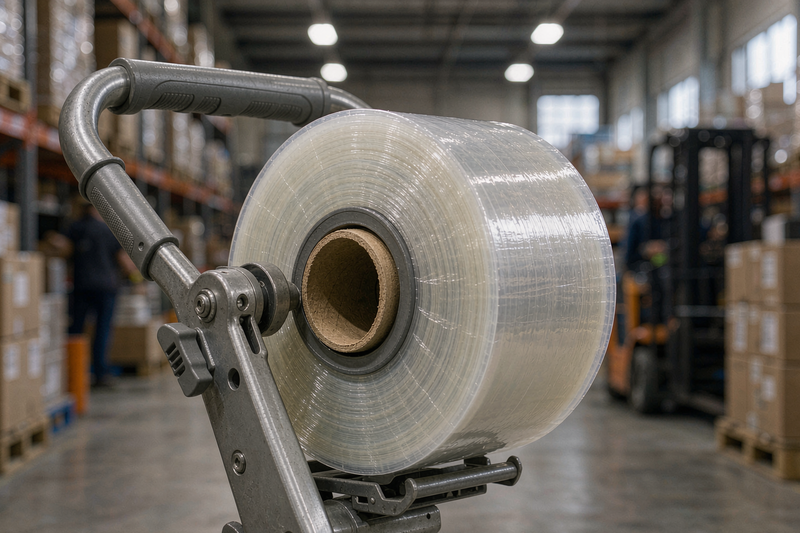
Some sites run extended core at satellite wrapping points where workers move around, and standard core with dispensers at the main packing bench where throughput is highest. The two formats do not need to be unified across the warehouse, but the procurement decision should be explicit about which station gets which format.
Procurement Checklist: What to Confirm Before Ordering
- Core specification: extended core tube diameter, protrusion length on each side, and whether the protrusion is cardboard only or includes a plastic end-cap. Standard core ID (commonly 1.5" or 3") and core material.
- Roll weight and length: actual roll weight, not nominal; affects how many pallets the worker can wrap before fatigue limits output.
- Dispenser compatibility: if buying standard core, confirm the roll fits the dispensers in use, including any existing ergonomic models with adjustable handles.
- Film grade: same resin system, nlele, and width can be specified in either core format; do not let the core decision force a film downgrade.
- Start cling: both formats need enough cling to start the wrap on the pallet without tape; confirm this is built into the film rather than relying on operator technique.
- Unwind noise: extended core is typically quieter; if the warehouse noise profile matters, confirm by sample rather than by spec sheet.
- Disposal stream: confirm whether the core material matches the site’s recycling stream; some extended cores use a different cardboard grade that needs separate handling.
- Supply format: if the operation buys stretch film in jumbo rolls for converting in-house, confirm the mill offers both core types at the same lead time.
- Trial quantity: order a small quantity first, run the trial for at least one full shift per worker, and measure wrap count, reported strain, and any film waste before standardising.
Common Mistakes When Choosing Between the Two Formats
- Buying extended core to fix a bad dispenser problem. If the workers are straining because the dispensers are wrong, replacing the dispensers delivers more relief than switching core format and keeps the cheaper consumable.
- Choosing standard core to save money and skipping the dispensers. Bare-roll application of standard core is the worst ergonomic outcome of all three options; the saving on consumable is usually smaller than the cost of the strain it produces.
- Assuming all dispensers are equal. A lightweight plastic dispenser with no tension control can be worse than a well-designed extended core roll. Spec the dispenser if standard core is selected.
- Standardising one format across the whole site. Different stations have different ergonomic profiles; a one-format policy is often a compromise that does not serve any station well.
- Treating the per-metre premium as small change. Across a high-volume operation, the 5–15% premium on extended core adds up; make sure the ergonomic benefit is real before absorbing the cost.
- Measuring ergonomics on day one. Strain builds across a shift and across weeks. A two-day trial almost always favours the familiar option. Run the trial long enough to capture real fatigue patterns.
Key Takeaways
- Extended core hand stretch film uses a longer cardboard tube that doubles as a built-in handle; standard core uses a short core that needs a dispenser or a pinch grip on the bare roll.
- The ergonomic gap between the two comes from grip, wrist position, and roll weight, not from the film itself.
- Standard core paired with a quality ergonomic dispenser can match or beat bare-roll extended core on most strain metrics.
- Extended core suits lower-volume, mobile, or trainer-heavy operations; standard core suits fixed high-volume stations and mixed fleets.
- The 5–15% per-metre premium on extended core is real and should be justified by measured ergonomic outcomes, not by intuition.
- Trial each format across at least one full shift per worker, on the actual pallets and stations, before standardising.
Frequently Asked Questions
Is extended core hand film actually easier on workers?
It removes the need for a dispenser and lets the worker hold a wider cardboard handle with the wrist closer to neutral. The benefit is real for low-to-moderate wrap counts, but it is not a substitute for fixing a poorly chosen or missing dispenser on standard core.
What core size is standard on hand stretch film?
Most standard core hand film uses a 3-inch ID cardboard core, with 1.5-inch cores less common and usually limited to narrow or pre-stretched film. The exact specification should be confirmed with the supplier before ordering, particularly if the operation runs a mixed fleet of dispensers.
Can I use a dispenser with extended core film?
Yes, but the dispenser must be sized for the wider core. Standard dispensers will not accept an extended core roll. If the site already runs dispensers, confirm the dispenser model fits the extended core tube before committing to the format.
Does extended core film cost more?
Typically 5–15% more per metre than standard core of the same grade, because fewer mills run the format at scale and changeover costs are higher. The premium should be weighed against measured reductions in strain and any change in wrap-count-per-shift productivity.
How do I decide which format to trial first?
Start with the format that best matches the operation’s wrap count and station layout. Low-volume or mobile stations favour extended core; fixed high-volume stations usually favour standard core with a quality dispenser. Run each for at least one full shift per worker before deciding.
Should I keep both formats in stock?
If the warehouse has more than one type of wrapping station, yes. A single-format policy is rarely the lowest-strain option across the whole site, and the procurement complexity of carrying two SKUs is small compared to the ergonomic gain of matching format to station.
Next Step: Match the Core Format to the Station
The right choice depends on wrap count per shift, station layout, and whether the operation already runs a dispenser fleet. Send us your shift volume, number of wrapping stations, whether workers are mobile or fixed, and the dispenser models currently in use, and we will recommend a core format and, where relevant, dispenser specification for each station rather than a one-size answer. Share your wrapping setup and we will work from your numbers.