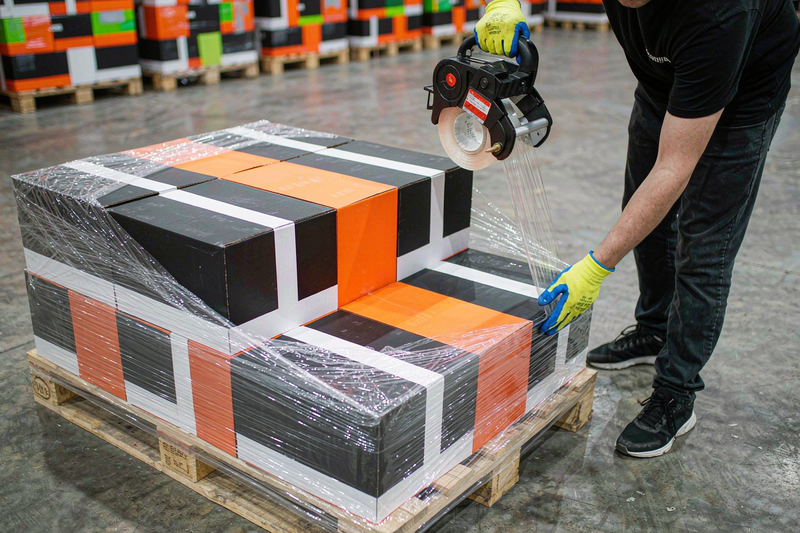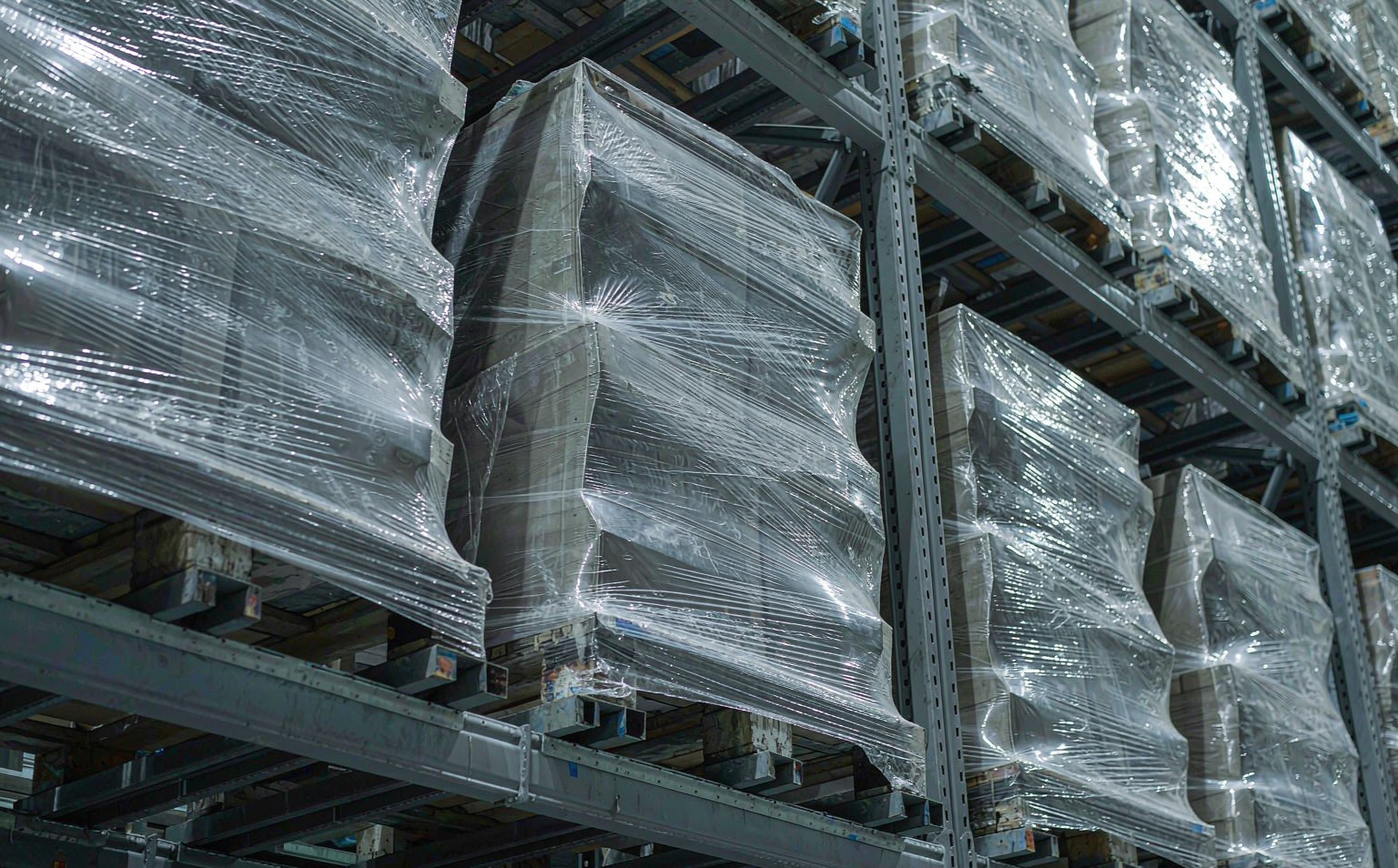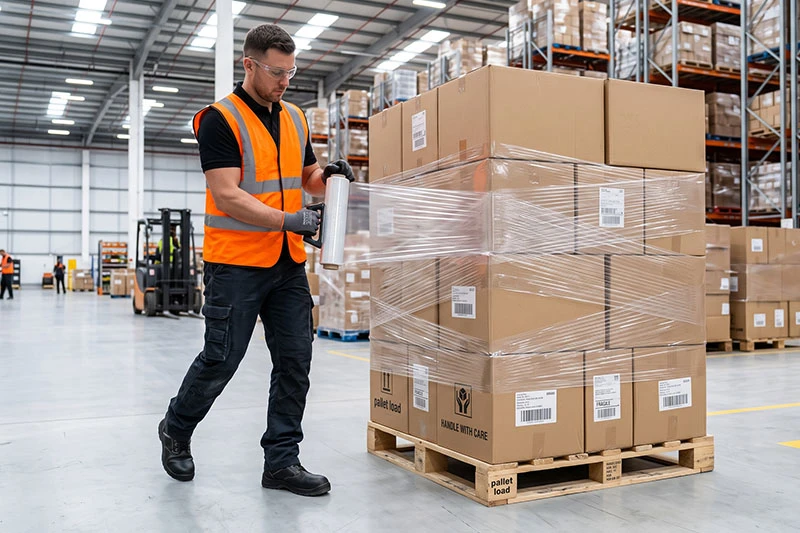


Machine wrap and strapping are the two most common ways to secure a palletized load, and procurement teams regularly face the same question: which one costs less? Comparing the price of a roll of film to the price of a coil of strapping tells you almost nothing. What matters is the total cost of ownership — the sum of every cost each method generates across material, equipment, labor, damage, disposal, and switching.
This article breaks those categories down side by side, identifies where each method is the lower-cost choice, and walks through how to run the comparison against your own operation rather than against a generic benchmark.
What Total Cost of Ownership Actually Includes
Total cost of ownership is the sum of every cost a containment method generates over a fixed period, divided by the number of pallets shipped in that period. For most operations, that means six categories: material, equipment, labor, damage and claims, disposal or recovery, and the cost of changing back when a method fails.
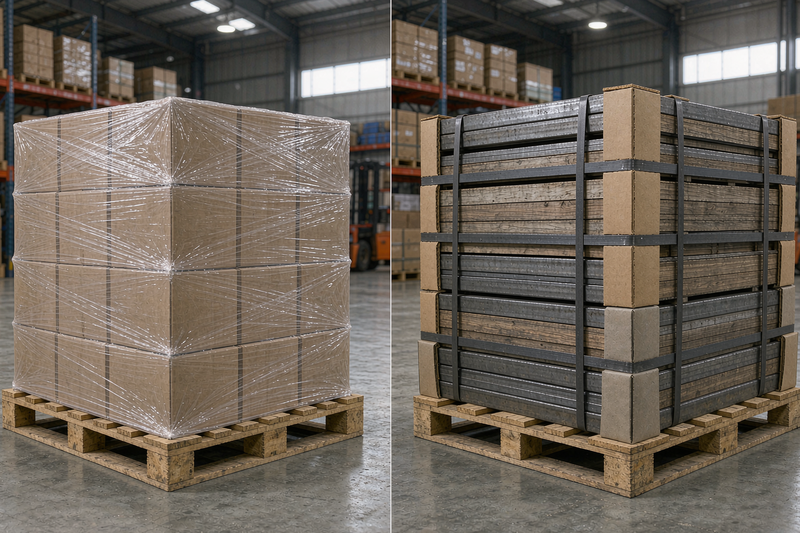
Comparing the price of a roll of film against the price of a coil of strapping tells you almost nothing on its own. Film is consumed by the pallet in grams; strapping is consumed in bands per pallet, plus the recurring cost of seals, buckles, tools, and maintenance. The two methods also differ in what they cost you when they work: film wraps five sides and stabilizes the entire load, while strapping applies high tension at a few specific points and does nothing for dust, moisture, or the shifting of individual cartons between those points.
| Cost category | Machine stretch wrap | Бәйләү (PET / PP / steel) | What to measure |
|---|---|---|---|
| Material | Film weight per pallet, governed by gauge, сузылу алдыннан катнашу, and wrap pattern | Band length per pallet, plus seals, buckles, or friction-weld consumables | Consumable units used per 1,000 pallets |
| Equipment | Күчергеч, әйләнүче кул, or ring wrapper; low mechanical complexity | Hand tools, pneumatic tools, or automatic strapping heads; higher maintenance burden | Capex amortized over expected service life, plus annual maintenance |
| Labor | Operator loads and unloads; cycle runs unattended | Operator positions and tensions each band; more manual steps per pallet | Touch minutes per pallet, fully loaded wage rate |
| Damage and claims | Failure mode is gradual loss of containment force | Failure mode is sudden: one broken band releases the load | Claim rate per 1,000 shipments and average claim value |
| Disposal and recovery | Single-polymer LLDPE, widely recyclable where collection exists | Steel is recyclable; PET and PP need separation from the load | Per-site recycling rules and any producer-responsibility fees |
| Switching cost | Low: film grade and pattern can be changed in minutes | Higher: tooling, band sizes, and operator retraining | Cost of a failed trial, including re-handling |
None of these categories can be calculated from a supplier datasheet. They come from your own line, your own warehouse, and your own claim history.
Where Machine Wrap Costs Less
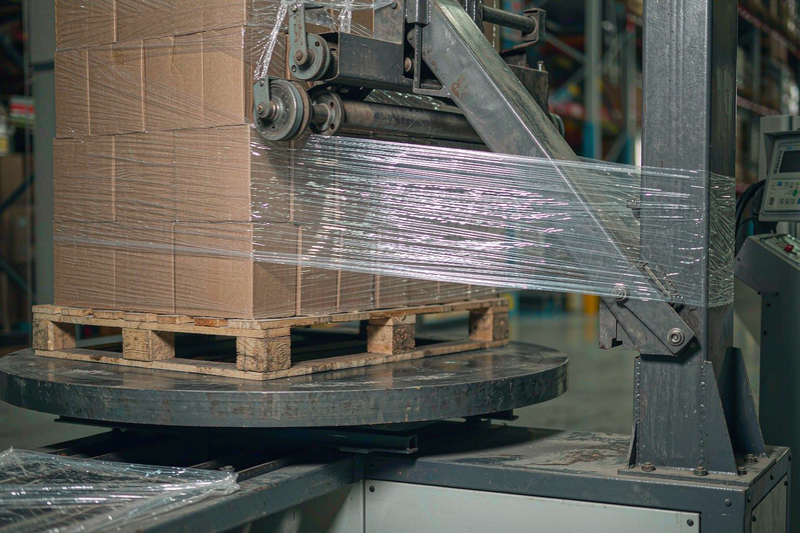
Material efficiency through pre-stretch
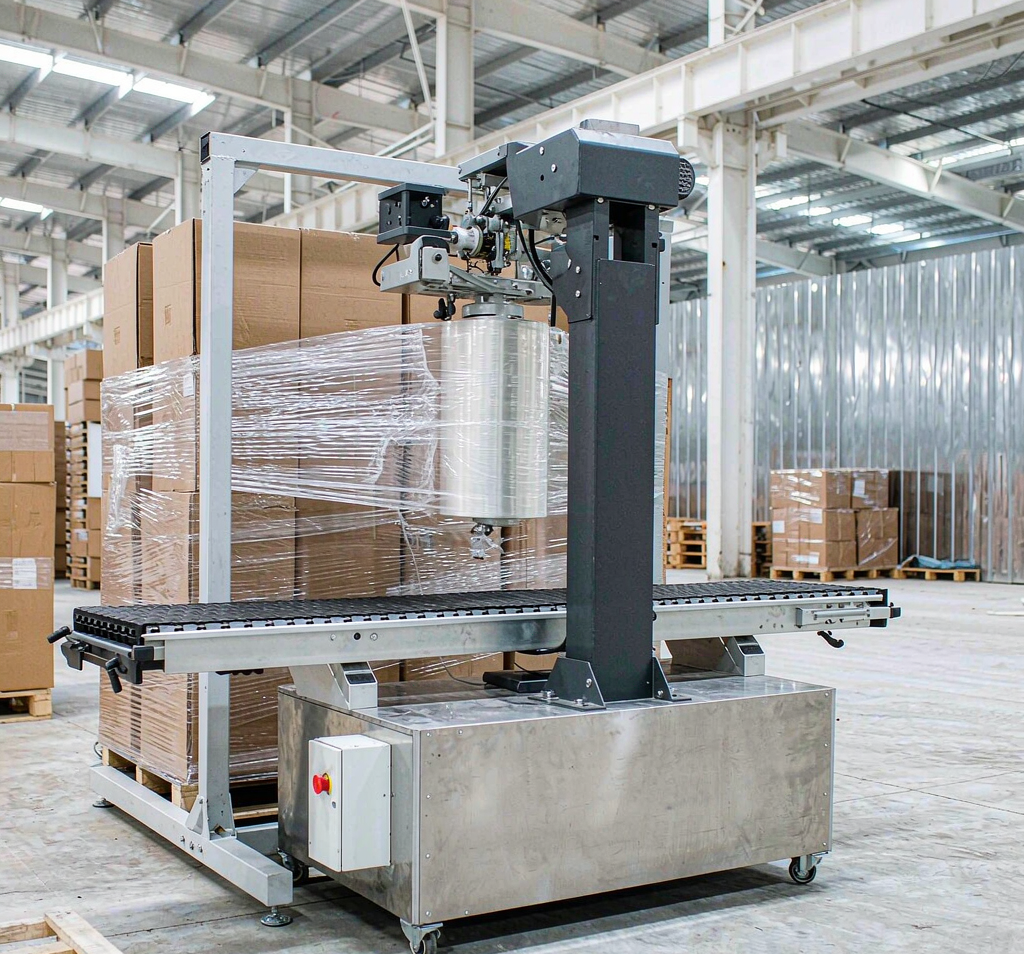
Machine wrappers stretch the film before it reaches the load, so one metre of film leaving the roll can cover substantially more than one metre of pallet surface. The ratio depends on the machine’s pre-stretch setting and on how much of that stretch the film retains elastically. This is why машина сузу пленкасы is specified by yield rather than by gauge alone: a thinner film stretched further can deliver more wrapped pallets per roll than a thicker film run at low pre-stretch.
The practical consequence is that material cost per pallet is a function of machine setup as much as of film price. Two warehouses buying the same roll at the same price can have different per-pallet costs because one runs a higher pre-stretch ratio and a tighter overlap.
Labor and cycle time
Once the cycle starts, a machine wrapper runs without an operator. The operator’s time is spent positioning the pallet and starting the cycle, not on the wrapping itself. Where pallet volumes justify the equipment, this is usually the largest single advantage in the TCO calculation.
Damage profile
Film distributes containment force across the entire load surface. When it begins to lose force, it does so gradually: the load starts to loosen and the problem is usually visible before product is lost. That gives a chance to intervene during handling rather than discovering the failure at the destination.
Film fails differently. A single broken band can release the whole load, and the failure often happens in transit where nobody sees it until the pallet arrives.
Coverage
Film closes the five exposed faces of a pallet. For cartoned goods, bagged product, and anything sensitive to dust or moisture during transit, that coverage has value that strapping does not provide, and it removes the need for a separate hood or top sheet in many applications.
Where Strapping Wins
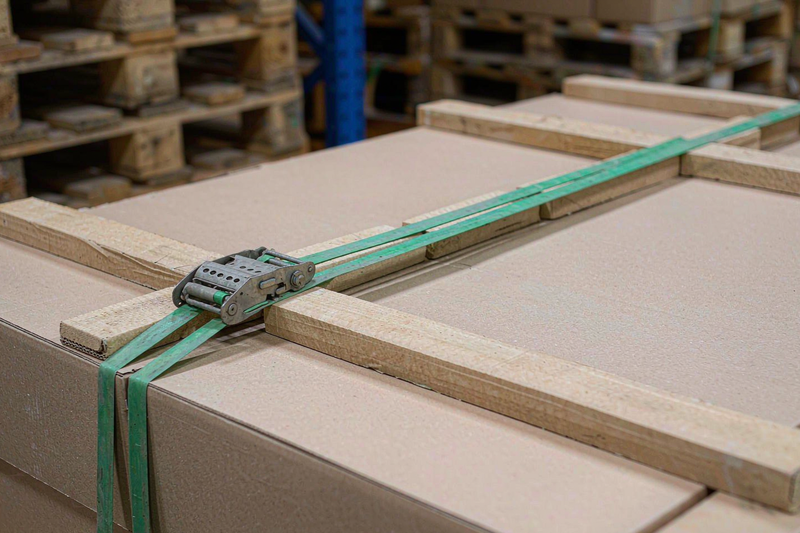
Very heavy or rigid unit loads
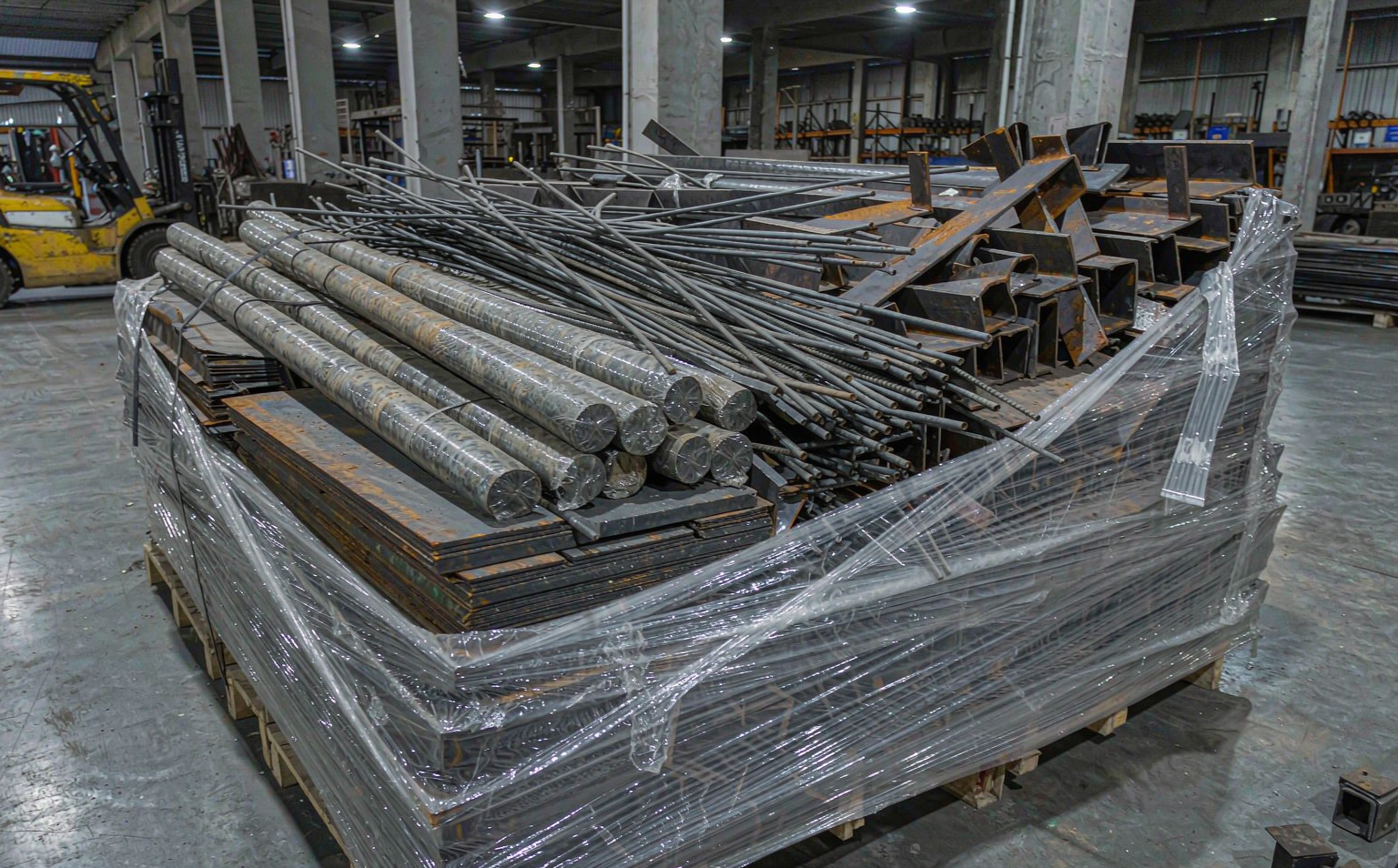
Steel coil, brick, block, sawn timber, and bundled metal profiles present loads that do not compress and do not need distributed containment. They need a few very strong bands holding them to the pallet or to each other. Film cannot generate that kind of point tension without being applied in quantities that remove its cost advantage.
Long-term outdoor storage and elevated temperature
Stretch film relies on elastic recovery to hold a load. Over long storage periods, and especially at elevated temperature, that recovery decays: the film relaxes and containment force drops. Strapping does not depend on elasticity to hold tension, so for pallets stored outdoors for months or shipped through sustained heat, it holds where film would need reinspection or rewrapping.
Loads with sharp edges that cut film
Sharp-edged product can puncture film at the contact point, and a puncture becomes a tear under tension. Strapping with edge protection handles geometries that would require a heavy anti-puncture film grade and careful wrap programming.
Regulatory or customer-mandated securing
Some export and intermodal requirements specify strapping or a specific combination of methods. In those cases the comparison is not optional, and the relevant question becomes how to meet the requirement at the lowest total cost within the constraint.
The Hybrid Option: Wrap and Strapping Together
The two methods are not always substitutes. A common configuration uses strapping for vertical retention of very heavy or rigid product and film over the top for dust protection, load unity, and the containment of individual units within the pallet. Another uses film as the primary containment method with a band added where a specific load feature, such as an overhanging top layer or an unusually tall stack, needs anchoring.
Whether the hybrid costs less than either method alone depends on how much of the cost is driven by damage claims. If your failure mode is top-layer shifting rather than total containment loss, adding one band may be cheaper than increasing film layers across every pallet. Hybrid configurations also help during transitions: running both for a few weeks is usually much cheaper than a single major claim from an unvalidated method.
How to Build Your Own TCO Comparison
The comparison only needs to be accurate for your operation, not universal. Work through these steps using your own data, in this order, and resist the temptation to short-cut the measurement step with supplier estimates.
- Define the unit. One loaded pallet of your most common SKU profile, or one pallet of your most problematic load if damage is the issue. The unit should match the unit your claim history is reported in.
- Measure consumables. For film, record grams used per pallet at your current pre-stretch setting and wrap pattern. For strapping, record band length, number of bands, and seals or buckles per pallet. Do this for at least 20 pallets across at least two shifts to smooth out operator variation.
- Measure touch time. Time the operator from pallet arrival to cycle completion for each method, including any repositioning or band tensioning. Convert to fully loaded cost per minute.
- Amortize equipment. Divide the installed cost of the wrapper or strapping equipment by its expected service life in pallets, then add annual maintenance divided by annual pallet count. If equipment is shared across multiple lines, allocate by pallet share.
- Price the failures. Pull your claim history by load type. A method that costs more per pallet but eliminates a recurring damage pattern is cheaper overall, and the difference can be substantial.
- Add disposal. Confirm what your site or your customer’s site can actually recycle, and whether separation is required before disposal. Include any producer-responsibility fees.
- Run a controlled trial. Wrap and ship the same load profile both ways for a defined period, then compare consumables, labor, and claims over that period. A trial that runs on a single shift or single load type is not representative.
If your volumes or equipment configuration differ from what the trial covered, the exact figures should be confirmed with your supplier before committing to a change across all lines.
Procurement Checklist: What to Confirm Before Switching
- Load profile: авырлык, dimensions, compressibility, кыр үткенлеге, and whether the load is uniform or irregular.
- Storage and transit conditions: expected duration, temperature range, outdoor exposure, and number of handling events.
- Wrapper capability: maximum pre-stretch ratio, whether the carriage allows variable wrap force by layer, and whether the film tail is clamped or wiped.
- Film specification: үлчәү, pre-stretch rating, тешләү каршылыгы, cling level on both sides, and whether the grade suits your ambient temperature. Confirm current options on the машина сузу пленкасы page.
- Supply format: roll width, core size, and rolls per pallet. Larger formats such as сузылган фильм джумбо ролллары reduce changeover frequency on high-volume lines.
- Backup method: what happens if the wrapper is down. If the answer is hand wrapping, confirm you hold a suitable кул сузу фильмы grade.
- Customer requirements: any mandated securing method, documentation, or recyclability requirement.
- Trial metrics: what you will measure, over how many pallets, and who signs off on the result.
Common Mistakes When Comparing the Two
- Comparing roll price instead of cost per pallet. A cheaper roll at low pre-stretch can cost more per wrapped pallet than a premium film run at high pre-stretch.
- Ignoring the labor line. Manual banding adds touch minutes per pallet that are easy to overlook and expensive at volume.
- Testing only on the easiest load. The comparison matters most on the load that generates claims.
- Assuming film performs the same in heat. Containment force decays faster at elevated temperature; verify under your actual conditions.
- Skipping edge protection. Strapping without corner protection concentrates force onto carton edges and creates a new damage pattern.
- Changing several variables at once during a trial. If you change film grade, wrap pattern, and band count together, you will not know which change produced the result.
Төп алымнар
- Total cost of ownership covers material, equipment, labor, damage, disposal, and switching cost, not consumable price alone.
- Machine wrap usually wins on labor, cycle time, and five-sided coverage for uniform cartoned pallets shipped on short, climate-controlled cycles.
- Strapping wins on very heavy or rigid loads, long-term or high-temperature storage, sharp geometries, and mandated securing requirements.
- Film fails gradually and visibly; strapping fails suddenly at the point of band breakage, and the cost of that failure mode is often the deciding line in the TCO calculation.
- Hybrid configurations are often the lowest-cost answer when a specific load feature, not the whole load, is causing failures.
- The only reliable comparison uses your own consumable, labor, and claim data over a defined trial period; supplier benchmarks are starting points, not conclusions.
Еш бирелә торган сораулар
Is machine stretch wrap always cheaper than strapping?
.К. For uniform cartoned pallets moved on a standard cycle, machine wrap is usually lower cost per pallet once labor is included. For very heavy, rigid, яки үткен кырлы йөкләр, and for long-term outdoor storage, strapping often costs less over the full shipping cycle.
Can stretch film replace strapping entirely?
It can for many distribution loads, but not where a customer specification, an export requirement, or the nature of the load demands point tension. Confirm the requirement before removing strapping from a validated load pattern.
How much film does a wrapped pallet use?
It depends on gauge, сузылу алдыннан катнашу, number of wraps, overlap, and load dimensions. Measure grams per pallet on your own line rather than relying on a generic figure, because machine setup changes the result more than film price does.
Does strapping damage cartons?
It can. Strapping concentrates force on a narrow band, and without corner protection it crushes carton edges. If you switch to strapping, include edge protection in the material cost and check carton compression strength against the band tension you plan to use.
What about recyclability?
Stretch film is a single polymer, which simplifies recycling where LLDPE collection exists. Steel strapping is recyclable, and PET and PP strapping are recyclable but need separating from the load. What matters is what your facility and your customer’s facility actually accept.
How long should a TCO trial run?
Long enough to capture your normal mix of loads, routes, and seasonal temperatures. A short trial on a single load type will not reveal how either method behaves under your worst-case conditions.
Next Step: Compare Against Your Own Numbers
The decision between machine wrap and strapping comes down to your load profile, your handling conditions, and your claim history, not to a generic comparison. If you send us your pallet dimensions, load weight, transit and storage conditions, and current consumable usage, we can help you work out which method carries the lower total cost for your operation, and where a hybrid configuration makes more sense than either method alone. Share your wrapping requirements and we will start from your numbers rather than from a generic benchmark.