

ASTM testing methods are the closest thing buyers have to a common language for evaluating machine stretch film. When a supplier quotes ‘ASTM D882 tensile strength’ or ‘ASTM D1709 dart drop,’ they are referring to standardized procedures that define how the film is stretched, punctured, torn, and impacted under controlled conditions. The results, read correctly, tell you whether a film will hold your pallet in the warehouse or fail at the first corner.
This article breaks down the ASTM tests that actually matter for machine stretch film buyers, explains what each number means in practical terms, and shows how to use test reports to compare suppliers without getting lost in the jargon.
Why ASTM Standards Matter to Buyers, Not Just Labs
Most procurement teams see an ASTM test report as a laboratory curiosity. It is not. A well-documented test sheet is a predictor of field performance — if you know which tests map to which failure modes. A film with low ASTM D5748 puncture energy will tear on sharp pallet corners. A film with poor ASTM D5458 cling will unravel in transit. A film whose ASTM D882 elongation at break is too low will snap under high pre-stretch on a zaj duab xis stretch tshuab wrapper.
The key is to stop treating test data as marketing decoration and start using it as a technical filter. The tests described below are the ones that directly affect whether your load arrives intact.
ASTM D882: Tensile Strength and Elongation
ASTM D882 measures how a film sample reacts when pulled in opposite directions until it breaks. The test reports two numbers that matter:
- Tensile strength at yield and at break — the force per unit width the film can withstand before permanent deformation (yield) and before rupture (break). Higher is generally better, but the number must be read against gauge: a 23-micron film will naturally show higher force than a 12-micron film.
- Elongation at break — how far the film stretches before it snaps, expressed as a percentage of its original length. Machine stretch films typically show 200–400% elongation depending on resin and formulation. Higher elongation means the film can absorb more stress during wrapping and transport.
What to watch for: suppliers who quote tensile strength without stating whether it is at yield or at break, or who omit the test speed and gauge. ASTM D882 is run at a defined crosshead speed; comparing numbers from different speeds is misleading. The exact specification should be confirmed with the supplier.
ASTM D1709: Dart Drop Impact Resistance
This test drops a weighted dart onto a clamped film sample from a fixed height and records the mass that causes 50% of samples to fail. It simulates the kind of point impact a pallet load faces during handling — a forklift bump, a corner strike, or dropped goods.
For machine stretch film, dart drop is particularly relevant for:
- Irregular loads with protruding edges
- Pallets that undergo frequent handling or cross-docking
- High-value products where film failure means damage, not just rework
Dart drop results scale with gauge and resin. A 20-micron metallocene-based film can outperform a 25-micron conventional LLDPE film on this test. Do not assume thicker means tougher; ask for the dart drop mass at the gauge you are actually buying.
ASTM D1922: Propagation Tear Resistance (Elmendorf)
Once a film is nicked or punctured, how far does the tear travel? ASTM D1922, the Elmendorf tear test, answers this. A pre-cut sample is torn by a swinging pendulum, and the force required to propagate the tear is measured in grams or Newtons.
This matters because real-world film damage is rarely a clean puncture — it is a tear that starts at a corner and runs. A film with high propagation tear resistance contains the damage locally rather than allowing a rip to unwind half the pallet. For applications involving sharp edges, hardware, or unboxed products, this test is essential.
ASTM D5748: Protrusion Puncture Resistance
While dart drop simulates flat impact, ASTM D5748 uses a rounded probe to push through the film at a controlled speed, measuring the force and energy required. This test better represents the slow, steady pressure of a pallet corner or box edge pressing against the film during storage and transit.
Puncture resistance is the difference between a film that dimples and recovers and one that splits open. For high-bay storage and automated warehouses where pallets sit under their own weight for extended periods, this is often the most important test in the suite.
ASTM D5458: Cling Force
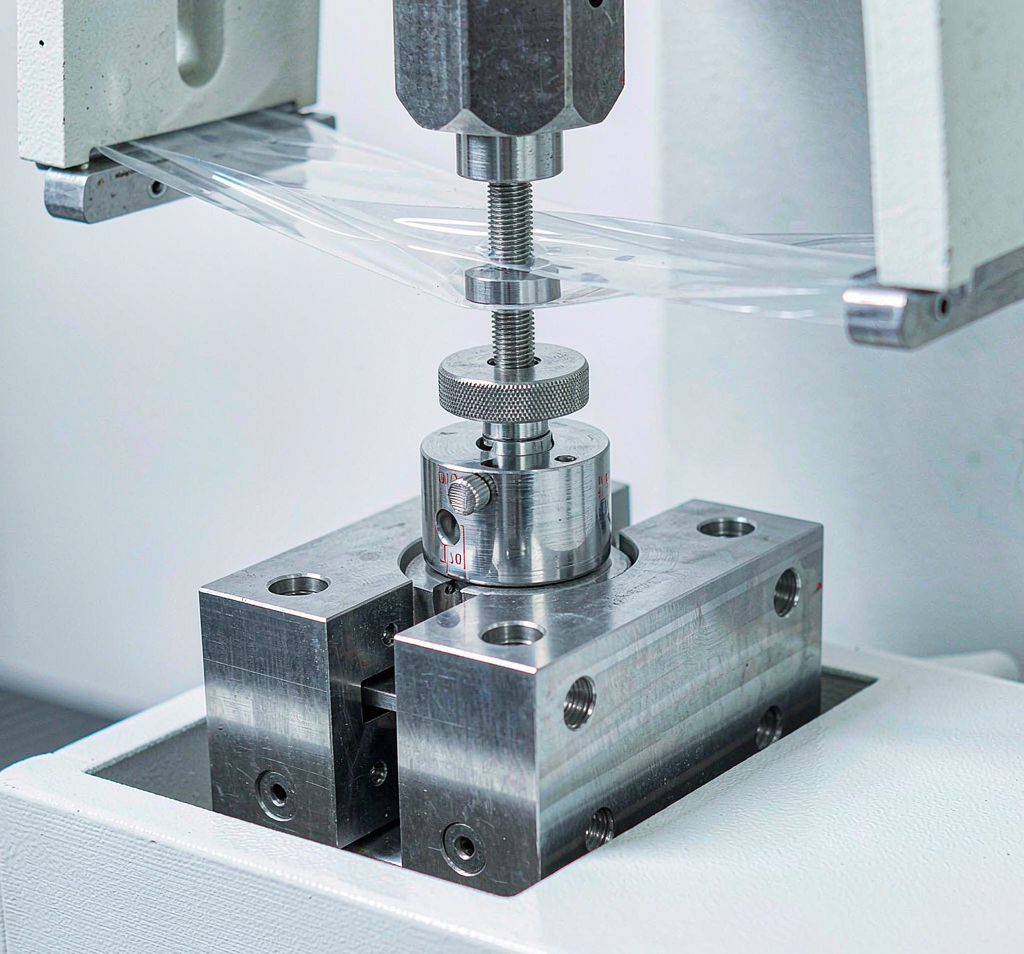
Cling is what holds the film to itself on the pallet. Without adequate cling, layers slip, the wrap loosens, and containment force drops. ASTM D5458 measures the force required to separate two film layers that have been pressed together under standard conditions.
Cling is formulation-dependent, not structural. It is added via tackifiers in the outer skin layers and can be tuned single-sided or double-sided. Too little cling and the pallet unwraps; too much and the film sticks to itself on the roll, causing handling problems and waste. The correct cling level depends on your product, storage climate, and wrapping equipment.
Supporting Tests: Haze, Coefficient of Friction, and Thermal Shrinkage
Beyond the core mechanical tests, three additional standards are useful in specific applications:
- ASTM D1003 (Haze and Luminous Transmittance): measures optical clarity. Relevant if you need barcode scanning through the wrap or if you are evaluating color stretch film where tint consistency matters.
- ASTM D1894 (Coefficient of Friction): measures how easily film slides over itself or over carton surfaces. Important for high-speed lines where low friction prevents jams, and for stacked pallets where high friction adds stability.
- ASTM D2732 (Unrestrained Linear Thermal Shrinkage): measures how much the film contracts when heated. Relevant for films used in warm climates or near heat sources, and for applications where post-wrap shrinkage would over-tension the load.
How to Read a Supplier’s Test Report Like a Buyer
Test reports are only useful if you know what to demand. Here is what a credible report should include:
| Element | What to Look For | Red Flag |
|---|---|---|
| Test method | Explicit ASTM number and year (e.g., ASTM D882-18) | Vague references to “standard test methods” with no ASTM code |
| Sample gauge | Micron or mil thickness stated alongside every result | Results quoted without gauge — thicker film always tests higher |
| Test conditions | Temperature, humidity, crosshead speed, pre-stretch state | No environmental conditions listed |
| Direction | MD (machine direction) and TD (transverse direction) values | Only one direction reported; stretch film is anisotropic |
| Sample size | Number of specimens tested and standard deviation | Single-sample claims presented as guaranteed specs |
| Date and lab | Recent test date and identifiable testing facility | Outdated reports or unverifiable lab names |
When Test Data Matters Most
ASTM data is most valuable in three procurement situations:
- Qualifying a new supplier. Test reports let you compare Candidate A against Candidate B on the same metrics, rather than relying on sales claims.
- Downgauging or switching resin platforms. If you are moving from a 20-micron to a 17-micron film, or from conventional to metallocene LLDPE, test data shows whether the new film matches or exceeds the old one on the tests that matter for your loads.
- Procuring stretch film jumbo rolls for converting. Converters need consistent mechanical properties across the full roll length. A supplier who provides per-lot test data with tight standard deviations is signaling process control that minimizes waste and variation in your downstream operation.
Procurement Checklist: ASTM-Verified Machine Stretch Film
- Primary failure mode of current film identified (puncture, tear, loss of cling, neck-down, snap?)
- Load profile documented: weight, height, edge sharpness, handling intensity, storage duration
- Supplier asked for full ASTM test report with method year, gauge, conditions, MD/TD values, and sample size
- Key tests matched to failure mode: D5748 for puncture, D1922 for tear, D882 for tensile, D5458 for cling
- Results compared at identical gauge, not roll-to-roll
- Side-by-side pallet trial agreed, with containment force measured at identical wrap settings
- Storage test included if loads sit longer than 30 days
- Test report dated within 12 months and from a verifiable lab or in-house quality facility
Common Procurement Mistakes with Test Data
- Comparing results at different gauges. A 23-micron film will always show higher tensile force than a 17-micron film. Compare normalized values or test at the same gauge.
- Ignoring directionality. Machine stretch film is stronger in the machine direction than the transverse direction. A supplier who only reports MD values is hiding the weaker direction.
- Treating one test as a proxy for everything. High tensile strength does not guarantee high puncture resistance. Each test measures a distinct failure mode.
- Accepting outdated reports. Resin lots change, line conditions drift, and formulations evolve. Ask for data from the production lot you will actually receive.
- Skipping the pallet trial. Laboratory samples are flat and clean. Real pallets are dirty, sharp, and uneven. Test data narrows the field; pallet trials confirm the winner.

Key Takeaways
- ASTM test methods provide a standardized, comparable way to evaluate machine stretch film performance before it reaches your line.
- ASTM D882 (tensile/elongation), D1709 (dart drop), D1922 (tear), D5748 (puncture), and D5458 (cling) are the core tests that map directly to real-world failure modes.
- Always compare test data at the same gauge, in both machine and transverse directions, with stated test conditions.
- Test reports narrow the supplier field; wrapped-pallet trials confirm which film actually performs on your loads.
- Request recent test data from the specific production lot you will receive, not generic marketing specifications.
Frequently Asked Questions
Which ASTM test is most important for machine stretch film?
There is no single most important test — it depends on your failure mode. If film tears on sharp corners, prioritize ASTM D5748 (puncture) and D1922 (tear propagation). If film snaps during wrapping, prioritize ASTM D882 (tensile/elongation). If loads shift in transit, prioritize ASTM D5458 (cling) and conduct a containment force audit.
Can I trust a supplier’s in-house test data?
w, if the supplier follows the ASTM procedure correctly and provides full test conditions. Many manufacturers run in-house quality labs with calibrated equipment. Ask for the method, gauge, sample size, and standard deviation. A supplier who hesitates to share these details is a signal to look elsewhere.
What is the difference between MD and TD test values?
MD (machine direction) is the direction the film was extruded and stretched; TD (transverse direction) is across the web. Machine stretch film is typically stronger in MD because of the orientation process. Both directions matter because a pallet load stresses the film in multiple orientations during handling and transport.
How often should test data be updated?
For ongoing supply contracts, ask for a certificate of analysis with each delivery or at minimum quarterly. If the supplier changes resin source, gauge, or line configuration, new test data should be provided before the changed product ships.
Do I need all ASTM tests for every purchase?
No. Focus on the tests that map to your known failure modes. A buyer wrapping stable cartoned goods in a climate-controlled warehouse needs fewer tests than a buyer shipping sharp-edged hardware through variable temperatures. The exact test suite should be confirmed with the supplier based on your application.
Is higher elongation always better?
Not necessarily. Very high elongation can mean the film stretches easily but recovers poorly, leading to relaxed wraps over time. What matters is the balance between elongation and elastic recovery — how much of the stretch the film returns from after wrapping. Depending on the machine configuration, this balance can be verified through load retention testing.
Conclusion
ASTM testing methods are not laboratory abstractions — they are the closest thing buyers have to a performance preview. Understanding which tests map to which real-world failure modes, demanding complete test conditions, and validating lab numbers with pallet trials is how procurement teams move from buying on price to buying on verified performance.
If you need machine stretch film with documented ASTM test data for your pallet profiles — or want a side-by-side trial against your incumbent film — send your load specifications and current test reports, and we will match the right film grade and gauge to your operation.