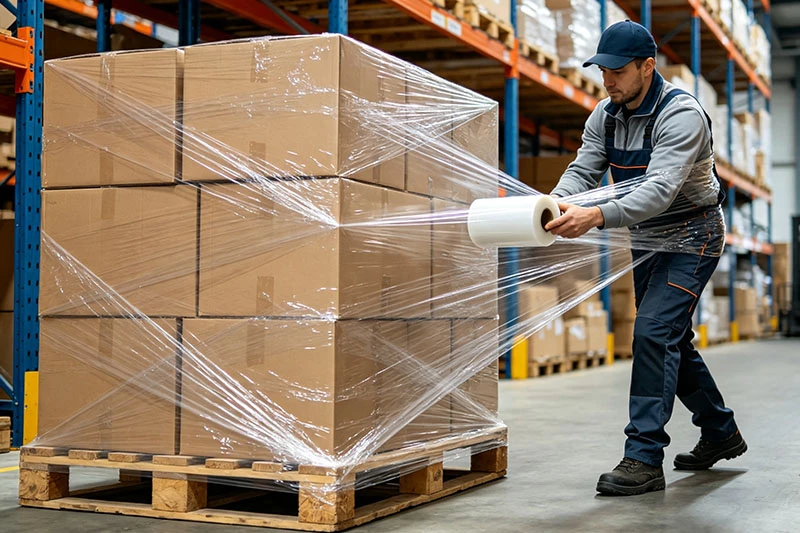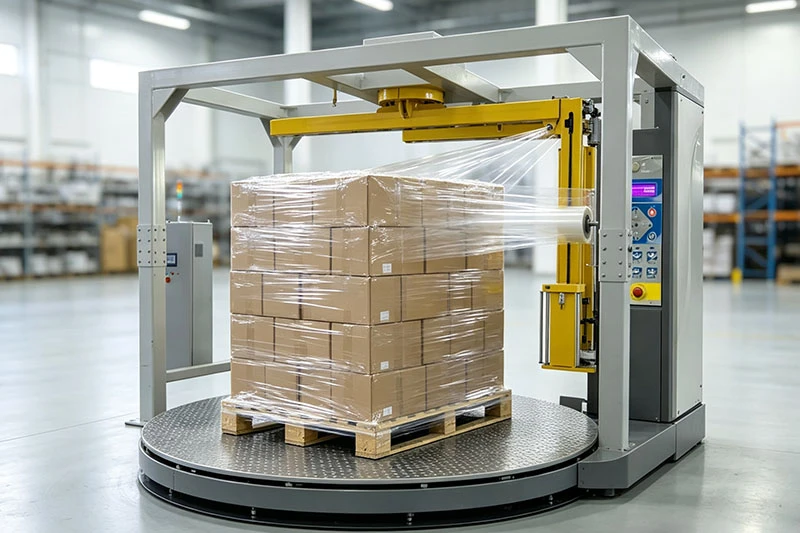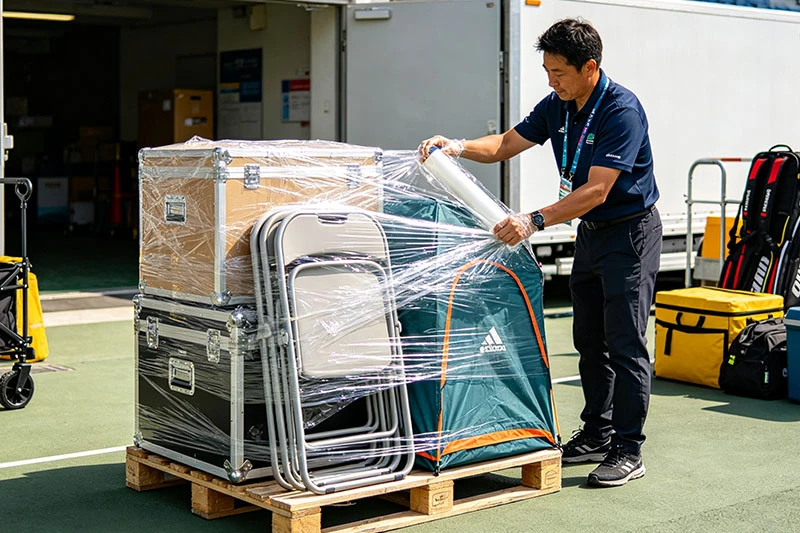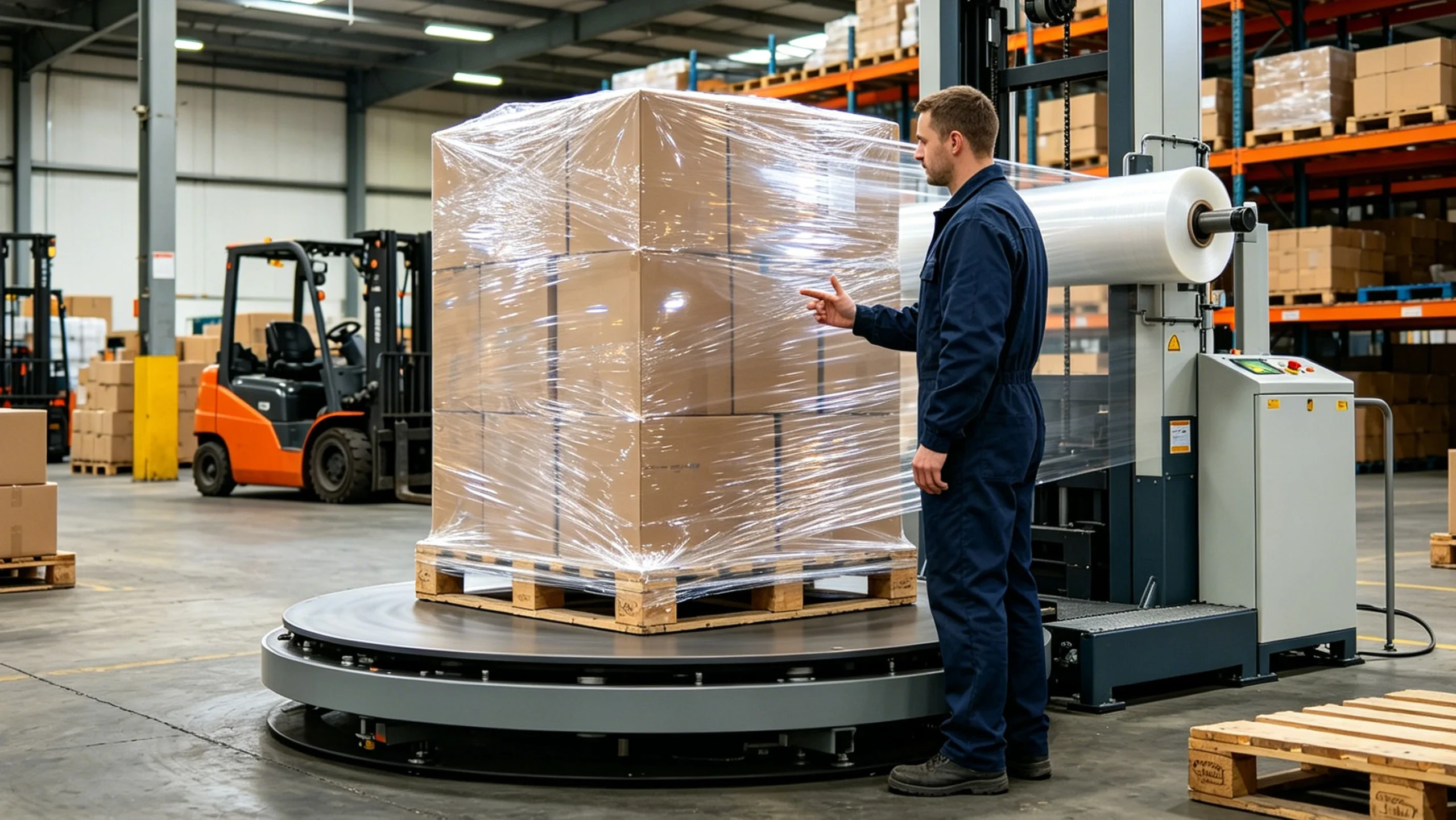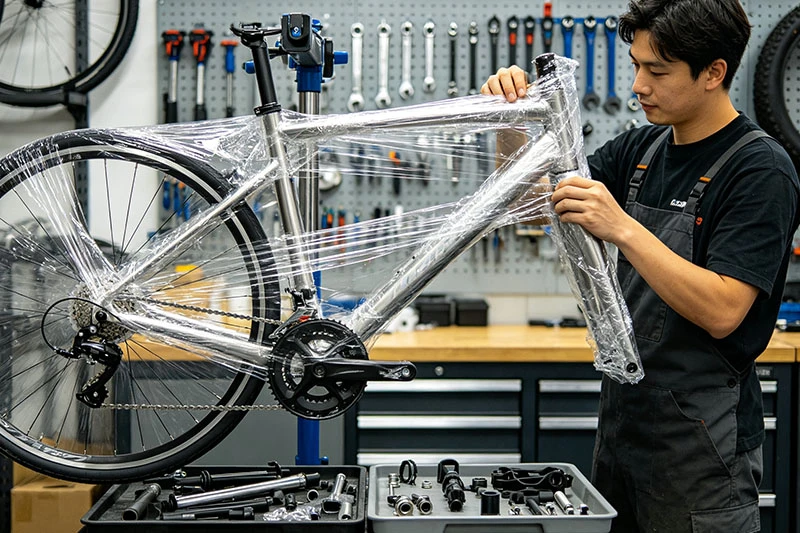


Implementing pre-stretched film in manual warehouse packaging operations allows facilities to lower plastic resin consumption by up to 30% to 50% while significantly reducing physical operator fatigue. Conventional hand stretch wrap requires operators to exert high physical tension during application to achieve proper elongation. When operators tire, they apply un-stretched film, which leads to loose pallet loads, excessive material consumption, and higher cost per wrapped unit.
This guide outlines the return on investment (ROI) of switching to pre-stretched film. It explains the extrusion conversion process, provides a material savings calculation model, details workplace safety advantages, and addresses load containment force mechanics for B2B procurement managers and warehouse operations supervisors.

Rethinking Manual Pallet Wrapping: The Business Case for Pre-Stretch Technology
In traditional manual pallet wrapping, operators must physically stretch conventional film as they walk around a pallet skid. When operators fail to stretch conventional film to its optimal yield point, up to 40% of the film’s functional elongation potential is wasted.
CONVENTIONAL HAND WRAP APPLICATION
[ Operator Physical Tension Required ] ---> [ Inconsistent Elongation ] ---> [ High Resin Waste & Physical Strain ]

PRE-STRETCHED FILM APPLICATION
[ Mechanically Elongated in Factory ] ---> [ Consistent Applied Tension ] ---> [ Lower Weight & Zero Worker Strain ]
Pre-stretched film eliminates this dependency on human force. The film is mechanically elongated during converting near its ultimate tensile limit before being wound onto hand rolls.
Core Operational Advantages
- Immediate Weight Reduction: Because the film is pre-elongated into a thinner profile, each linear meter of applied film weighs substantially less than standard gauge hand wrap.
- Consistent Load Containment: The film applies uniform holding force regardless of worker fatigue, shift length, or operator technique.
- Streamlined Wrapping Motion: Operators simply walk around the pallet and apply light guiding tension, eliminating the need to backward-tug or violently stretch the roll.
Integrating ergonomic pre-stretched hand stretch film solutions addresses both variable material expenses and workplace health and safety compliance within logistics environments.
Engineering Behind Pre-Stretch Processing: How Cold-Stretch Converting Works
Understanding the physical structural changes that occur during pre-stretch converting explains why a thinner film can match or exceed the holding stability of thicker conventional wrap.
                                POLYMER MOLECULAR ALIGNMENT

Conventional Film (Un-Oriented)                     Pre-Stretched Film (Oriented)
 +---------------------------+                      +---------------------------+
 |  ~  ~  ~  ~  ~  ~  ~  ~   |                      |  =======================  |
 |   ~  ~  ~  ~  ~  ~  ~  ~  |  == Cold-Stretch ==> |  =======================  |
 |  ~  ~  ~  ~  ~  ~  ~  ~   |                      |  =======================  |
 +---------------------------+                      +---------------------------+
 (Random Polymer Chain Matrix)                      (Aligned Linear Polymer Chains)
During manufacturing, high-grade LLDPE blown or cast film passes through precision rollers rotating at differential speeds. This cold-stretch conversion pulls the polyolefin matrix past its elastic limit into its plastic yield zone.
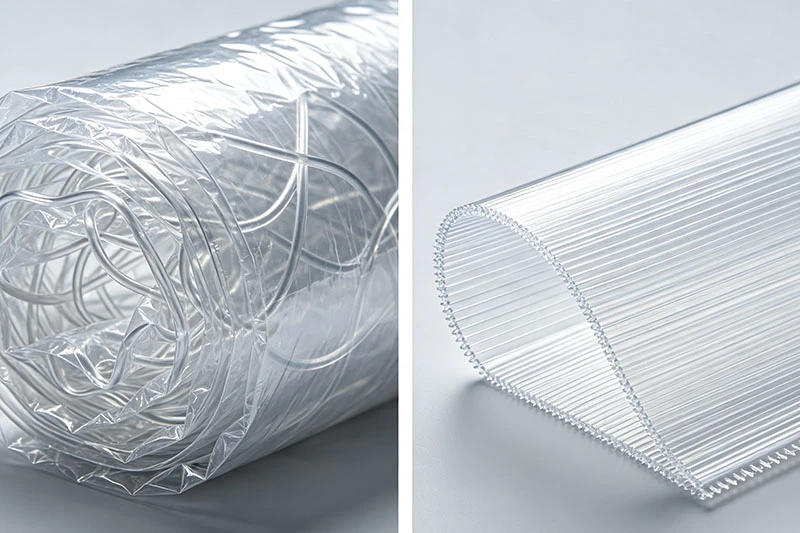
Technical Performance Matrix: Conventional vs. Pre-Stretched Film
| Mechanical Property | Conventional Hand Stretch Film | Pre-Stretched Hand Film | Operational Impact |
| Manufacturing State | Un-oriented polymer structure | Pre-elongated near yield point | Eliminates manual stretching on the warehouse floor |
| Applied Gauge / Thickness | 17 µm – 23 µm (67 – 90 Gauge) | 7 µm – 10 µm (28 – 40 Gauge) | Reduces total plastic mass consumed per pallet |
| Neckdown (Width Reduction) | 20% – 35% under manual pull | Minimal / Width remains stable | Preserves full roll coverage width during wrapping |
| Application Tension Effort | High physical effort required | Minimal guiding tension needed | Eliminates back strain and wrist fatigue |
| Roll Edge Profile | Standard straight cut | Rolled or folded reinforced edges | Prevents edge tears when rolls are dropped |
By locking the polymer chains in an elongated state, the converted material exhibits minimal neckdown. Standard hand stretch film loses width when pulled hard, requiring more total wraps to cover a pallet from top to bottom. Pre-stretched film maintains its width, ensuring maximum surface coverage per revolution.
Calculating Material Savings: Reducing Resin Consumption by Up to 50%
For operations managing high daily shipping volumes, converting to pre-stretched wrap directly reduces resin consumption and lowers waste disposal fees for end customers.
Material Consumption Formula
To calculate the total weight of plastic consumed per pallet, measure the net weight of the applied film:
$$\text{Film Mass Per Pallet (Grams)} = \text{Total Applied Length (Meters)} \times \text{Width (Meters)} \times \text{Thickness (Microns)} \times \text{Density}$$
Because pre-stretched film thickness is roughly half that of traditional hand wrap, the material mass required to achieve equivalent load containment decreases proportionally.
Material & Cost Optimization Comparison Model
| Parameter | Standard Hand Wrap (20 µm) | Pre-Stretched Wrap (9 µm) | Variance / Savings |
| Film Weight Used Per Pallet | ~250 – 300 Grams | ~120 – 150 Grams | 45% – 50% Resin Reduction |
| Pallets Wrapped Per 1,000 kg Resin | ~3,600 Pallets | ~7,000 Pallets | ~94% Output Increase Per Ton |
| Operator Energy Expenditure | High (Repetitive pulling) | Low (Guiding walk) | Reduced physical fatigue |
| Waste Disposal Footprint | Higher plastic scrap volume | Lower plastic scrap volume | Supports sustainability targets |
Upgrading to cost-effective pre-stretched hand stretch film lowers the overall cost per pallet wrapped, enabling purchasing departments to achieve significant material efficiency without changing existing manual packaging workflows.
Improving Workplace Ergonomics: Eliminating Operator Strain and Fatigue
Manual pallet wrapping is a physically demanding task in warehouse operations. Forcing operators to pull heavy rolls under high tension while walking backward or bending down to secure bottom pallet skids leads to repetitive strain injuries (RSI) and lower back fatigue.
                              ERGONOMIC STRESS FACTORS

     Standard Hand Wrap                              Pre-Stretched Film
+---------------------------+                   +---------------------------+
| • High Pulling Force      |                   | • Zero Pull Tension       |
| • Bending at Pallet Base  |   == Switch ==>   | • Walk-and-Wrap Motion    |
| • Rapid Operator Fatigue  |                   | • Constant Tension Control|
| • Inconsistent Coverage   |                   | • Reduced Wrist Strain    |
+---------------------------+                   +---------------------------+
Ergonomics Safety Checklist
Evaluating manual wrapping safety across your facility involves reviewing key operator physical stressors:
- Lower Back Force: Standard wrapping requires bending and pulling near the floor to secure the wooden skid. Pre-stretched film flows smoothly off the roll, eliminating the need to jerk or tug while stooped over.
- Wrist and Shoulder Tension: Because the pre-elongation is already built into the roll, operators do not exert wrist isometric force to maintain tension.
- Forward-Walking Safety: Operators using lightweight pre-stretched hand stretch wrap can walk forward around the pallet, maintaining full situational awareness of forklift traffic and surrounding warehouse hazards.
Overcoming the “Thinner Film” Myth: Ensuring Pallet Load Stability
A common concern during procurement evaluations is whether a thinner, 7 to 10-micron pre-stretched wrap can match the load holding power of a conventional 17 or 20-micron film.
                     LOAD CONTAINMENT MECHANICS

  Conventional Film                     Pre-Stretched Film
+--------------------+                +--------------------+
| High Elasticity    |                | Rigid Stress Memory|
| Relaxes Over Time  |                | Locks Load Tight   |
| Risk of Shifting   |                | Zero Stretching    |
+--------------------+                +--------------------+
Understanding Retractive Stress Memory
When conventional film is pulled by hand, it retains high elasticity and can slowly stretch out or relax during transport. In contrast, pre-stretched film has already reached its functional yield point. Once applied, its tight molecular alignment creates high retractive stress memory, locking the load in place with minimal post-application stretching.
Folded Edge Technology
High-performance pre-stretched rolls feature folded or doubled edges. This reinforced edge structure acts as a double-strand border along the top and bottom of the film web. If a minor nick or puncture occurs from a sharp carton corner during wrapping, the folded edge stops the tear from propagating across the roll, keeping the wrap intact.
Facilities handling irregular cargo profiles or sharp-edged cardboard master cartons can rely on durable hand stretch film options with reinforced edges to secure loads safely throughout long-distance transit.

Key Takeaways
- Up to 50% Material Reduction: Pre-stretched film achieves substantial plastic resin savings per pallet by delivering thinner, pre-elongated wrap without sacrificing surface coverage.
- Enhanced Operator Ergonomics: Eliminating the need for high physical pulling tension reduces worker fatigue, back strain, and wrist injuries associated with manual wrapping.
- Consistent Containment Force: Polymer alignment gives pre-stretched film high retractive stress memory, preventing load loosening and shifting during transport.
- Resistant to Tear Propagation: Folded roll edges reinforce the web, preventing minor punctures from causing complete roll tears.
Frequently Asked Questions
Is pre-stretched film suitable for wrapping Profile C (irregular or sharp corner) loads?
Pre-stretched film performs reliably on Profile C loads when engineered with double-folded edges or produced from high-toughness LLDPE resins. For severely sharp metal corners or heavy protruding parts, testing sample rolls with reinforced edge profiles ensures puncture resistance meets application requirements.
How does the cost per roll of pre-stretched film compare to conventional hand stretch film?
While pre-stretched film rolls may carry a slightly higher converting price per roll due to the additional processing steps, the total cost per wrapped pallet is lower. Because each roll provides greater usable linear length without neckdown, fewer rolls are required to wrap the same total volume of pallets.
Can pre-stretched hand film be used with standard core hand dispensers?
Yes. Pre-stretched film is compatible with standard hand wrapping core sizes and lightweight manual dispensers. Because application requires minimal pulling force, operators can also wrap effectively using simple extended-core rolls or manual palm grips.